Free ATS Resume Checker, Built for India
See your resume the way a company’s hiring software sees it. ClearRound scores your resume against real Applicant Tracking Systems, shows you the keywords you are missing, and flags the formatting that gets you filtered out, before a recruiter ever looks.
No credit card · 1 free scan · Built for Indian companies
What is an ATS resume checker?
An ATS resume checker shows you how your resume performs against the software companies use to filter applications, before a human ever reads it. Most large companies do not read every resume by hand. They use an Applicant Tracking System (ATS) that scans, parses, and ranks resumes first. If yours is not formatted in a way the system can read, or is missing the keywords it looks for, it can get filtered out before anyone sees it.
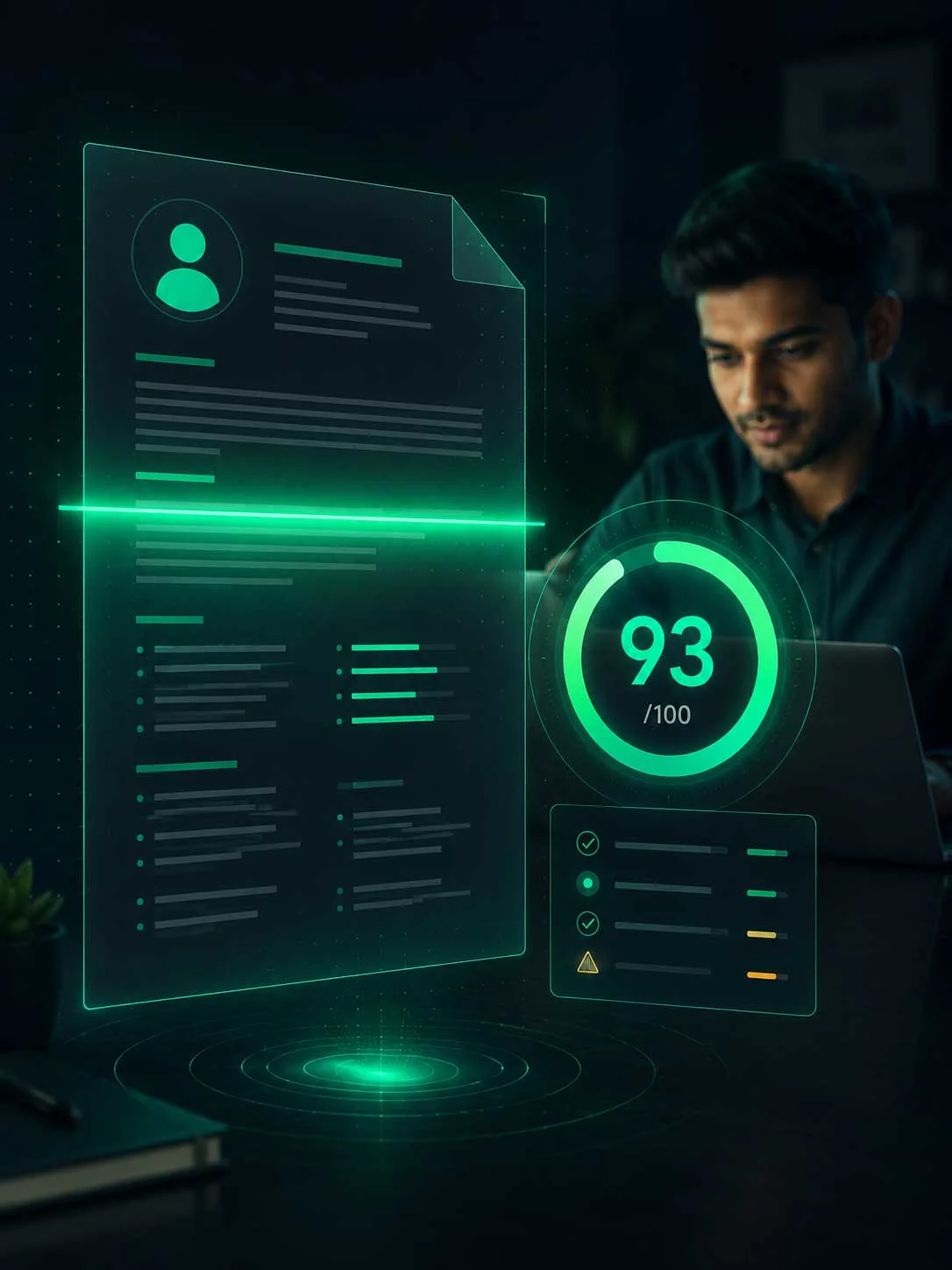
ClearRound's ATS resume checker scans your resume against real ATS systems, gives you a score out of 100, and tells you exactly what is holding you back. You see the keywords you are missing from the job description, the formatting issues that trip up the parser, and the sections that need work, each with a specific fix.
One thing that makes it different: the scoring is not a mysterious AI guess. It runs on transparent, rule-based checks, so you can see exactly why you scored what you did and what to change. No black box.
How the ATS resume checker works
- 1
Upload your resume
Upload a PDF, DOCX, or paste your text. ClearRound reads and parses it the way an ATS would.
- 2
Add the job description (and target company)
Paste the JD you are applying to. If you name the company, ClearRound checks against the ATS that company actually uses.
- 3
Get your ATS score and the breakdown
You get a score out of 100, built from three checks: how well the system can parse your resume, how well your keywords match the job, and whether your resume is complete.
- 4
See the exact fixes
Every issue comes with a concrete fix. "Replace tables with plain text lists." "Add these missing keywords." "Your dates are in a format the parser may misread." You know exactly what to change.
- 5
Fix it and scan again
Make the changes and re-scan to see your score climb.
MISSING KEYWORDS
Why good resumes get rejected by ATS
You apply to dozens of roles and hear nothing back. It is easy to assume you are not qualified. Often that is not the problem. The problem is that your resume never reached a human.
Here is what happens. A company posts a role and gets hundreds of applications. An ATS scans every resume, tries to read it, matches it against the job description, and ranks the results. Recruiters often look only at the top of that ranked list. If the software cannot parse your resume cleanly, or it does not contain the keywords the role calls for, you sink to the bottom, no matter how good you actually are.
The most common reasons a strong candidate gets filtered out:
Formatting the software cannot read
Tables, columns, text boxes, icons, and unusual fonts confuse many parsers. Your resume might look great to a human and be unreadable to the machine.
Missing keywords
If the JD asks for "Kubernetes" and your resume says "container orchestration," a literal keyword match can miss it. Some systems use knockout rules that filter you out entirely for a missing required skill.
Contact details in the header or footer
Some ATS systems do not read headers and footers, so your name and phone number can vanish.
Missing or mislabelled sections
If the parser cannot find a clear "Experience" or "Skills" section, it cannot score you properly.
None of this means you are a weak candidate. It means your resume was not built for the software reading it first. That is exactly what an ATS checker fixes. Worried the market is the problem? See how to still get hired in 2026.
ATS checking built for Indian companies
Most resume checkers are built for the US market and the ATS systems used there. India is different. Indian companies use a mix of global systems and India-specific ones like Naukri's RMS, and which system a company uses changes what your resume needs.
ClearRound maps 57 Indian companies to the ATS they actually use, and models 7 real systems: Workday, Greenhouse, Taleo, iCIMS, SAP SuccessFactors, Lever, and Naukri RMS. Name your target company and the checker scores your resume against that company’s system, not a generic average.
This matters because the systems are not the same. A resume that scores well on one can score poorly on another. Workday is strict about required keywords. Different systems parse formatting differently. Checking against the right one means you are fixing what actually counts for that application.
What you get from a scan
A score out of 100
Built from three transparent checks, not an AI guess.
Parseability
Can the system actually read your resume? It checks column count, tables, icons, fonts, standard headers, where your contact details sit, file format, and more.
Keyword match
How well does your resume match the job description? It extracts the skills the JD asks for, matches them against your resume (including stemming and synonyms), and shows you exactly which required keywords are missing.
Completeness
Does your resume have what it needs? It checks for the core sections, a summary, contact details, real bullet points, and whether your bullets are backed by numbers.
Specific fixes
Every issue comes with a concrete instruction, so you are never left guessing what to change.
Start free, upgrade when you need more
Free
One full ATS scan, no credit card. Upload your resume, get your score, your keyword gaps, and your fixes. See exactly where you stand.
Pro · ₹199/week
Unlimited ATS scans, so you can check and re-check every resume against every job you apply to. Plus the rest of ClearRound: mock interviews, cover letters, company research and more. Cancel anytime.
Pro Max · ₹499/week
The 7-ATS Deep Scan. Instead of one system, your resume is scored against all 7 ATS at once, with a company-specific recommendation, a variance analysis that shows how much your score swings between systems, and AI-assisted bullet rewrites to close the gaps. For when the role really matters.
How to make your resume ATS-friendly
You do not need tricks to beat an ATS. You need a resume the software can read and match. A few rules that help with almost every system:
Use a simple, single-column layout
Avoid tables, text boxes, and multiple columns. They look fine to you and confuse the parser.
Use standard section headings
"Experience," "Education," "Skills." Do not get creative with names the system will not recognise.
Match the job description's language
If the JD says "Kubernetes," use "Kubernetes," not just "container orchestration." Mirror the exact terms where they are genuinely true for you.
Keep contact details in the body
Not in the header or footer, where some systems will not read them.
Back your bullets with numbers
"Scaled payments to 10,000 requests per second" beats "worked on payments." It reads better to humans and signals real impact.
Use a standard font and a clean file
A common font, a PDF or DOCX that parses cleanly, no icons or images where text should be.
Do all of this and your resume reads cleanly to the software and to the human after it. An ATS checker tells you which of these you are getting wrong, so you are fixing the right things.
ATS resume checker FAQs
See your score before a recruiter's software does.
Your first ATS scan is free. No credit card. Upload your resume, see how the software reads it, and fix what is filtering you out.
Check your resume free →Once your resume gets you the interview, practise for it with an AI mock interview.