
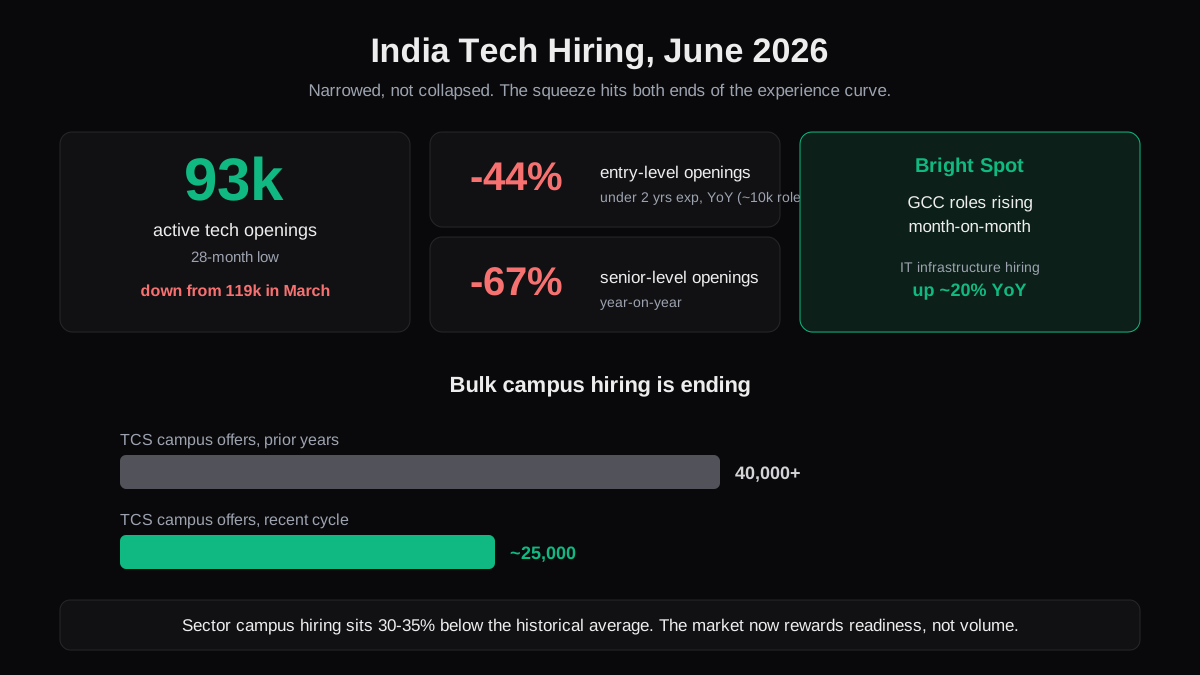
If your applications are vanishing into silence this year, you are not imagining it. In June 2026, active technology job openings in India fell to a 28-month low of around 93,000, down from 119,000 in March. For anyone with under two years of experience, the squeeze is sharper: entry-level openings dropped roughly 44% year-on-year, to about 10,000 roles.
Here is the part the panic headlines miss. The market did not stop hiring. It changed how it hires, from bulk to selective, from "fill the pipeline" to "hire the person who can contribute on day one." That shift is brutal if you apply like it is still 2022, and a genuine advantage if you adapt. This guide breaks down what actually changed and the exact moves that get you hired in a quality-over-quantity market.
Quick Facts: India Tech Hiring in 2026
| Signal | Number |
|---|---|
| Active tech openings, June 2026 | ~93,000 (28-month low, down from 119,000 in March) |
| Year-on-year drop in active openings | ~17% |
| Entry-level openings (under 2 years) | Down ~44% YoY, to ~10,000 roles |
| Senior-level openings | Down ~67% YoY |
| TCS campus offers, recent cycle | ~25,000 (down from 40,000+ in prior years) |
| Sector campus hiring vs historical average | 30-35% lower |
| Strongest bright spot | GCC roles (rising month-on-month) |
What Actually Changed: Bulk Hiring Is Over
For a decade, India's IT majors hired freshers in tens of thousands and trained them on the bench. That model is being dismantled in real time. TCS extended around 25,000 campus offers this cycle, roughly half the 40,000-plus it once made. Infosys is targeting about 20,000. Across the sector, direct campus hiring sits 30-35% below the historical average.
Three forces are driving it. AI now handles big chunks of the work freshers used to cut their teeth on: testing support, documentation, ticket summaries, basic coding assistance, and reporting. Companies shifted to "just-in-time" hiring, bringing people on only when a specific project needs them rather than maintaining a large bench. And global uncertainty, including ongoing H-1B policy questions, has pushed firms into a cautious "wait and see" posture.
The result is a barbell. Both ends of the experience curve got squeezed (entry-level down 44%, senior down 67%), while demand concentrated on a narrower band of immediately useful, specialised talent.
Insider Tip: "Just-in-time hiring" changes your timing strategy. Roles now open and close fast, tied to specific project wins. A profile that is already interview-ready, with resume polished and answers rehearsed, captures these windows. A candidate who needs two weeks to prepare after spotting the opening has usually missed it. In 2026, readiness is a speed advantage, not just a quality one.
Where the Jobs Actually Are
The slowdown is not uniform, and applying blindly to the cooling parts of the market wastes your effort. Demand is holding or growing in clear pockets:
- AI and machine learning: LLM fine-tuning, prompt engineering, applied ML. AI is cutting job volume in some areas while creating entirely new categories in others.
- Cloud, cybersecurity, data and DevOps: the infrastructure layer everything else runs on. IT infrastructure and support was the one segment that grew, up around 20% year-on-year.
- Product engineering: firms increasingly want builders over maintainers.
- Global Capability Centres (GCCs): the standout. These are no longer back offices; they build product, platform engineering, cybersecurity and AI for global markets. GCC openings rose month-on-month even as the broader market fell. If you are early-career, GCCs deserve the top of your target list.
The common thread: every resilient role rewards demonstrable, current skill over a generic degree. "I can learn on the job" was a fine pitch in a bulk-hiring market. In a just-in-time one, you need to show you already can.
The Mass-Apply Trap (and What to Do Instead)
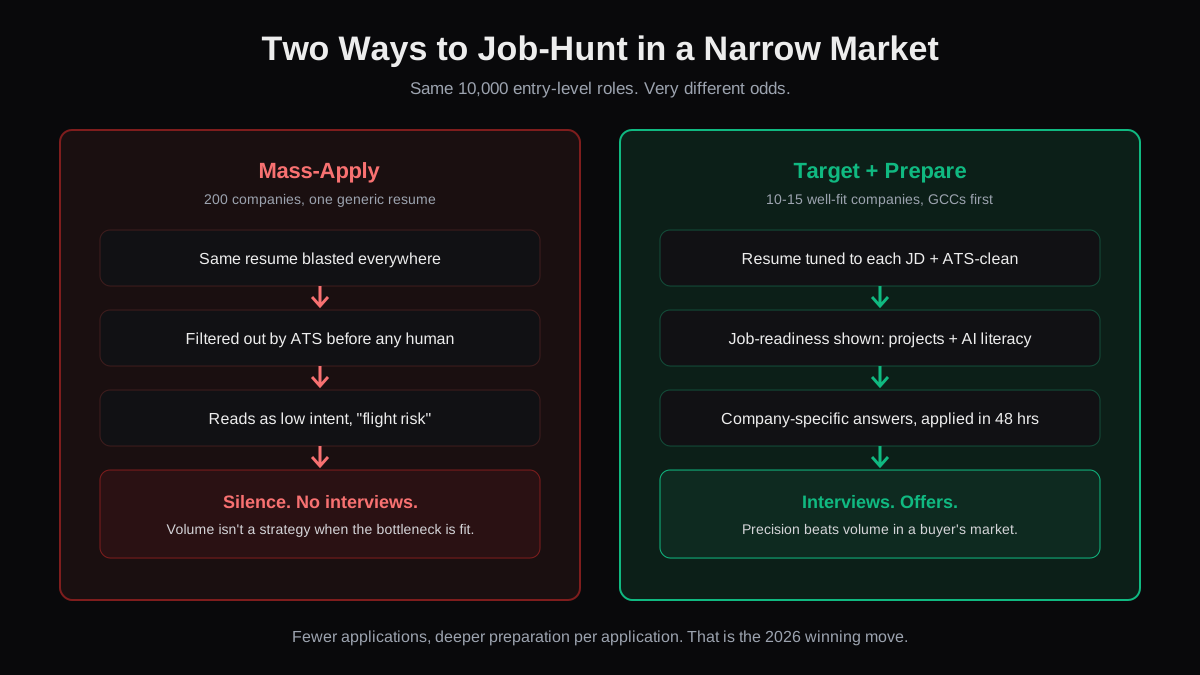
The instinctive response to a hard market is to apply everywhere. In 2026 this actively hurts you. When 10,000 entry-level roles attract applicants from multiple graduating batches plus laid-off juniors, a generic resume blasted to 200 companies gets filtered out by ATS before a human ever sees it. Volume is not a strategy when the bottleneck is differentiation.
The candidates getting hired are doing the opposite: fewer applications, deeper preparation per application. Here is the swap, as a concrete sequence:
- Pick 10-15 target companies, not 200. Weight the list toward GCCs and the resilient roles above. Quality of fit beats quantity of applications.
- Fix your resume for ATS first. Most rejections happen before any interview. Match your resume to each job description's keywords and confirm it parses cleanly against real ATS systems, our ATS-friendly resume format guide walks through the exact structure.
- Prove job-readiness. One or two real projects, a public repo updated in the last few months, and clear evidence of AI literacy now outweigh marks on a sheet. Recruiters explicitly say a degree no longer signals job-readiness.
- Practise the specific interview. Indian IT interviews are predictable: rounds, question patterns and rejection reasons repeat by company. Rehearse for the actual company, out loud, until your answers are tight, for example, the TCS interview process follows the same round structure every cycle.
- Move fast when a role opens. Because hiring is just-in-time, the prepared candidate who applies in the first 48 hours has a structural edge.
Insider Tip: In a buyer's market, recruiters lean harder on "flight risk" and "ramp-up time" as silent rejection reasons. Two questions decide more than you think: "Why this company specifically?" and "How quickly can you contribute?" Have a 30-second, specific, researched answer for each. Vague enthusiasm reads as mass-applying, and mass-applying reads as low intent.
Should You Worry About AI Taking the Role Itself?
It is a fair question when AI is cited as a reason for the cuts. But the honest data is calmer than the headlines. India's worker-weighted average AI exposure is about 1.9 out of 10, and only 4.5% of workers sit in high-exposure (score 7 or above) jobs. AI is reshaping tasks and team structures far more than it is deleting whole occupations.
The practical takeaway is not "panic" but "position." Software and clerical roles carry higher exposure; physical and judgement-heavy work carries much less. Before you pick which roles to target or which skills to deepen, it is worth checking where your specific occupation actually stands on the free AI Job Exposure map rather than reacting to vibes. Aim your preparation at the resilient, in-demand end, and the slowdown becomes a sorting mechanism that favours prepared candidates instead of a wall.
Your 7-Day Plan to Get Interview-Ready
A market this fast rewards being ready before the role appears. One focused week:
- Day 1: Run your resume through an ATS check and fix every parsing and keyword gap.
- Day 2: Build your target list of 10-15 companies, GCCs first, and pull each one's interview pattern.
- Days 3-5: One scored voice mock interview per day. Note your weakest dimension and re-drill it the next day.
- Day 6: Prepare 5 STAR stories covering delivery pressure, conflict, failure, learning and ownership. Most behavioural questions map to one of these.
- Day 7: Lock your two power answers: "why this company" and "how fast can I contribute." Rapid-revise must-mention points and 3 questions to ask the panel.
On day 8 you are not hoping the market improves. You are ready to capture the next opening the moment it appears.
Practice with our AI interviewer
Voice mock interview with scored feedback. Free session.
Start a mock interview →Frequently Asked Questions
Priti
AI interview preparation insights from the ClearRound team.