
"Tell me about yourself" is not an icebreaker. It's the most important question of your entire interview.
In the first 60 seconds, the interviewer decides whether you're worth listening to for the next 30 minutes. Interviewers often form a strong impression early, sometimes within your first answer, which is why your opening matters so much. A weak opener means you spend the rest of the interview recovering.
This guide gives you a formula that works for every stage, HR, technical, and managerial, with examples for freshers, experienced professionals, and career changers.
The Formula: Present → Past → Future (60-90 seconds)
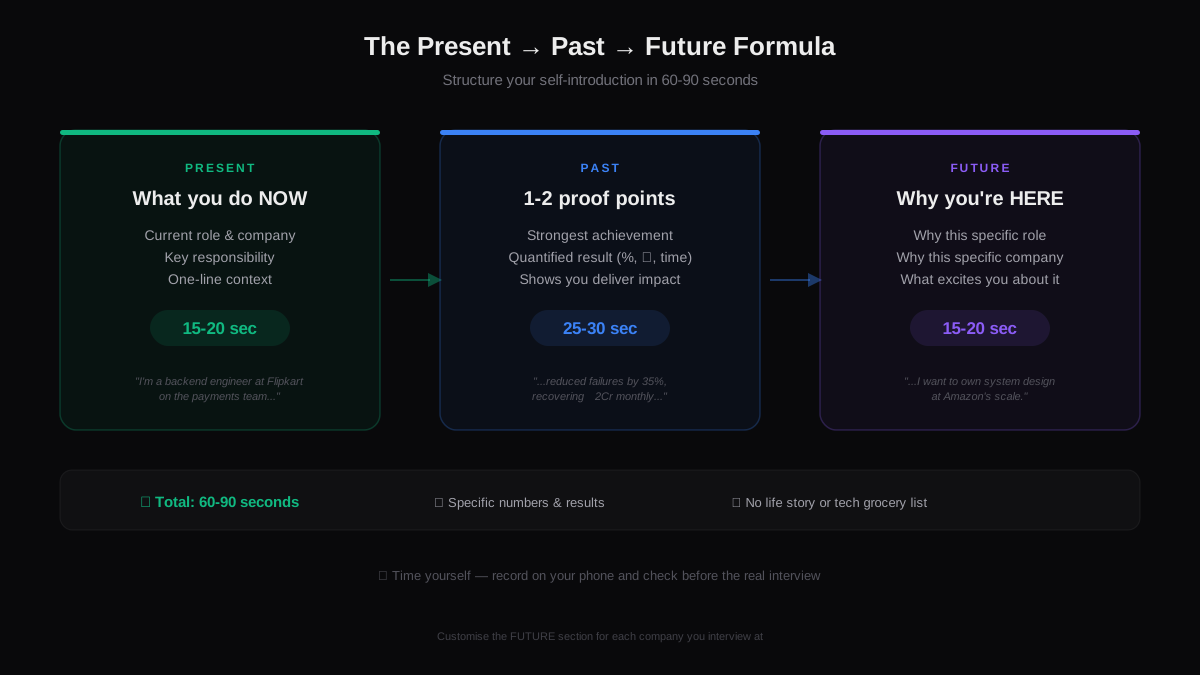
| Part | What to say | Time |
|---|---|---|
| Present | What you do NOW, role, company, key responsibility | 15-20 sec |
| Past | 1-2 highlights that PROVE you're good | 25-30 sec |
| Future | Why you're HERE, why this role, this company | 15-20 sec |
Total: 60-90 seconds. If you're past 90 seconds, you're rambling.
Example 1: Fresher (Campus Placement)
Weak answer: "Hi, my name is Priya. I'm from Pune. I studied B.Tech CSE at VIT. I know Java, Python, C++, HTML, CSS, JavaScript, React, Node.js, MongoDB, SQL, and Git. My hobbies are reading and playing chess."
Strong answer: "I'm a final-year CSE student at VIT Pune with an 8.2 CGPA. Over the last year, I've focused on full-stack development, my capstone project is a job board built with React and Node.js handling 500+ concurrent users. I interned at a Pune startup where I built their internal dashboard, reducing ops reporting time from 2 hours to 15 minutes. I'm applying to TCS Digital because I want to work on large-scale systems serving millions of users."
Why it works: Specific CGPA, one project with scale (500+ users), one internship with a result (2 hours → 15 minutes), and a reason for THIS company.
Insider tip (from a recruiter)
"When I hear 'Java, Python, C++, JavaScript, React, Angular, Vue, Node, Django, Spring Boot, MongoDB, PostgreSQL,' I immediately think: they can't do any of these well. List 3-4 technologies you can defend in depth. That's more credible than a grocery list of 15."
Example 2: Experienced Professional (3-5 years)

Strong answer: "I'm a backend engineer with 4 years at Flipkart, currently on the payments team. I build APIs that process 2 million transactions daily. Last quarter, I redesigned our retry mechanism for failed payments, reduced failures by 35% and recovered approximately ₹2 crore in monthly revenue. I'm interviewing at Amazon because I want to own end-to-end system design at even larger scale."
Why it works: Current role with scale (2M transactions), specific achievement with result (35%, ₹2Cr), clear reason for the move.
Example 3: Career Changer
Strong answer: "I spent 3 years as a marketing manager at a D2C brand driving ₹4 crore in annual revenue. During that time, I built internal analytics dashboards using Python and SQL, that's when I realised I wanted to move into product management. I've completed a PM certification from ISB, shipped a Chrome extension with 2,000 users, and spoken with 3 product teams to understand the role deeply. I'm excited about Razorpay's PM role because fintech combines my marketing background with analytical thinking."
Insider tip (from a hiring manager)
"For career changers, never say 'I got bored of my old field.' Show me the BRIDGE, what experience from your old career makes you better at the new one. 'I understand users because I spent 3 years talking to them' is 10x more convincing than 'I wanted a change.'"
5 Fatal Mistakes
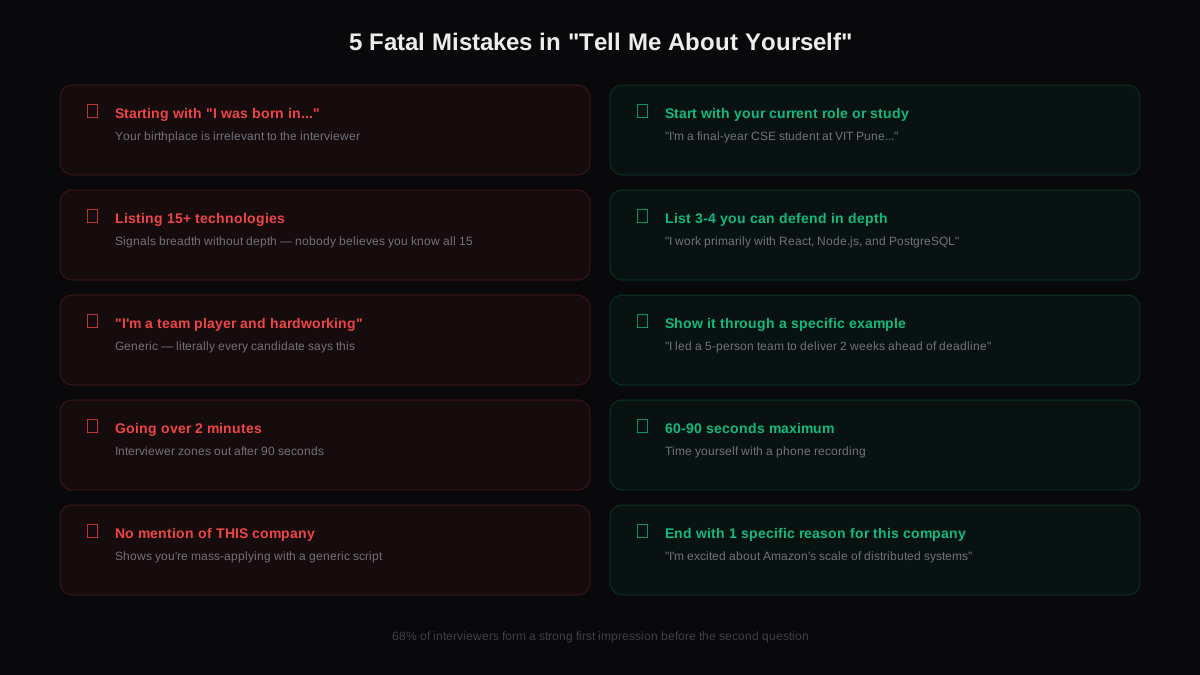
| Mistake | Why it fails | Say instead |
|---|---|---|
| Starting with "I was born in..." | Birthplace is irrelevant | Start with current role/study |
| Listing 15+ technologies | Signals breadth without depth | 3-4 you can defend |
| "I'm a team player" | Generic, every candidate says it | Show it via a specific example |
| Going over 2 minutes | Interviewer zones out | 60-90 seconds max |
| No mention of THIS company | Shows mass-applying | End with 1 specific reason |
Customise for Different Rounds
HR round: 60% personality and motivation, 40% achievements. End with why the culture appeals to you.
Technical round: 70% technical achievements and projects, 30% motivation. End with a technical interest matching the team's work.
Managerial round: Focus on leadership and business impact. Replace "I built X" with "I led the team that built X, resulting in Y."
The best way to rehearse is through mock interviews. They build the muscle memory so your answer sounds natural, not scripted.
Insider tip (from a recruiter)
"The candidates who nail this question have rehearsed, not memorised. Rehearsed means you know the key points and deliver them naturally in different words each time. Memorised means you sound like you're reading from a teleprompter, and if the interviewer interrupts, you lose your place completely."
Practice with our AI interviewer
Voice mock interview with scored feedback. Free session.
Start a mock interview →Frequently Asked Questions
Priti
AI interview preparation insights from the ClearRound team.