Why Mock Interviews Matter in 2026 (India)
Here's a number that should bother you: 73% of candidates in India get rejected after the first interview round, according to LinkedIn India's 2025 hiring data. Not because they lack skills. Not because they're underqualified. Because they walked in unprepared for how the interview actually works.
You studied Data Structures for 3 months. You solved 200+ LeetCode problems. You polished your resume until it gleamed. Then the interviewer said, "Tell me about yourself," and you froze for 8 seconds. That pause cost you the job.
Mock interviews fix this. Not motivational-poster-style "believe in yourself" fixes — actual, measurable, practise-until-it's-muscle-memory fixes. In this guide, you'll learn why mock interviews are the single highest-ROI activity in your interview preparation, how top candidates use them, and how to get started today — even if you have zero budget.
The Real Reason Candidates Fail (It's Not Knowledge)
Let's kill a myth: most interview rejections aren't about technical gaps.
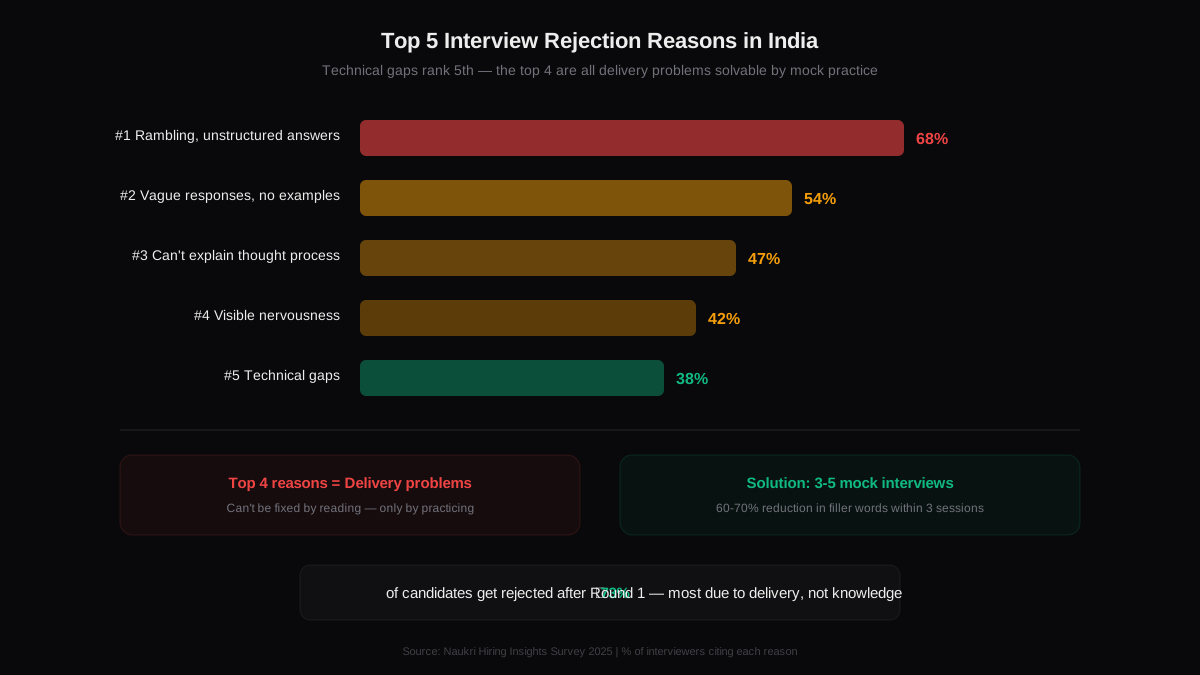
A 2025 survey by Naukri's hiring insights team found that 62% of interviewers reject candidates for communication and presentation issues, not technical incompetence. The top 5 rejection reasons look like this:
| Rank | Rejection reason | % of interviewers citing it | |---|---|---| | 1 | Poor structuring of answers (rambling) | 68% | | 2 | Lack of specific examples / vague responses | 54% | | 3 | Inability to explain thought process | 47% | | 4 | Visible nervousness / low confidence | 42% | | 5 | Technical gaps | 38% |
Notice that? Technical gaps rank fifth. The first four are all delivery problems. And delivery is exactly what mock interviews train.
You wouldn't walk on stage for a college fest without a rehearsal. You wouldn't present to a client without a dry run. Yet 80% of Indian job seekers walk into the highest-stakes conversation of their career with zero practice runs. That's what makes mock interviews non-negotiable.
Insider tip (from a recruiter): "I've interviewed 300+ candidates at Infosys and Accenture. The difference between a ₹8 LPA offer and a ₹14 LPA offer is almost never skill — it's articulation. Candidates who clearly practised their answers out loud, with structure, always score higher on our internal evaluation sheets. I can tell within 2 minutes if someone has done mock interviews."
What Mock Interviews Actually Train (The 5 Skills You Can't Learn from Books)
Reading interview tips is not the same as practising them. Here's what mock interviews build that no blog post, YouTube video, or course can replicate:
1. Answer Structuring Under Pressure
You might know the STAR method. But can you use it when an interviewer interrupts you mid-sentence, asks a follow-up you didn't expect, and the clock shows you've been talking for 90 seconds already?
Mock interviews train your brain to structure automatically. After 5-7 sessions, STAR becomes reflex, not recall. You stop thinking "okay, Situation first..." and just start telling a structured story naturally.
2. Time Awareness
The ideal behavioural answer is 90-120 seconds. The ideal "tell me about yourself" is 60-90 seconds. Most candidates have no idea how long their answers actually are. In mock interviews, you learn that your "quick answer" is actually 4 minutes long — and you learn to trim it.
3. Filler Word Elimination
"Basically", "actually", "you know", "so basically what happened was..." — these are invisible to you but painfully obvious to interviewers. Recording yourself in mock interviews (or having AI flag them) is the only way to catch and fix verbal filler.
4. Follow-Up Readiness
Real interviewers don't just ask a question and move on. They probe. "You said you improved performance by 40% — how did you measure that?" "What would you have done differently?" Mock interviews with probing follow-ups train you for the second question, which is where most candidates fall apart.
5. Confidence Calibration
There's a sweet spot between arrogance and under-selling yourself. Too confident and the interviewer thinks you lack self-awareness. Too modest and they think you lack conviction. Mock interviews help you find that exact calibre of confidence — and maintain it under pressure.
Insider tip (from a hiring manager): "At Amazon India, we use the 'bar raiser' system — a separate interviewer whose only job is to evaluate whether the candidate meets the hiring bar. These bar raisers are trained to probe weak answers aggressively. Candidates who haven't done mock interviews almost always crumble under bar raiser follow-ups because they've only prepared surface-level answers."
Types of Mock Interviews (and Which One You Need)
Not all mock interviews are equal. Here's a breakdown of every method, with honest pros and cons:
| Method | Cost | Realism | Feedback quality | Best for | |---|---|---|---|---| | Self-recording (phone/laptop) | Free | Low | Low (self-assessment bias) | Absolute beginners, day 1 | | Friend/peer practice | Free | Medium | Low-Medium (friends are too nice) | General comfort building | | AI mock interview (ClearRound) | Free tier available | High | High (structured, unbiased) | Behavioural + technical rounds, unlimited reps | | Paid human coach | ₹1,500 - 5,000/session | Very High | Very High | Final prep, 1-2 sessions before D-day | | College placement cell | Free | Medium | Varies wildly | Campus placement prep |
The smartest strategy? Combine them in phases:
Phase 1 (Week 1-2): Self-recording to identify your baseline. Record yourself answering "Tell me about yourself" and watch it back. Most candidates are shocked at how different they sound versus how they think they sound.
Phase 2 (Week 2-3): AI mock interviews for volume. You need 20-30 practice answers to build muscle memory. No human coach can give you that many reps affordably. AI gives you instant, structured feedback on every answer — STAR compliance, filler words, answer length, specificity score.
Phase 3 (Week 4): One human mock session to pressure-test. Have someone experienced play the role of a tough interviewer. This is your dress rehearsal.
Insider tip (from a recruiter): "The candidates who clear interviews at top companies — TCS Digital, Infosys Power Programmer, Flipkart — are not the ones with the highest CGPA. They're the ones who practised answers 10-15 times each. I once asked a candidate how many times she'd practised her 'tell me about yourself.' She said 22 times. She got the offer at ₹12 LPA. The next candidate with a higher CGPA couldn't get past the HR round."
The Mock Interview Framework: How to Practise Effectively
Doing 20 bad mock interviews is worse than doing 5 good ones. Follow this framework:
Step 1: Map Your Interview Rounds
Before you practise, know what you're practising for. Every company has a different interview structure. Research yours on AmbitionBox or Glassdoor, then build a round-by-round preparation plan.
Example for TCS Digital:
| Round | Type | What they test | Mock focus area | |---|---|---|---| | Round 1 | NQT (Online test) | Aptitude, coding, verbal | Timed practice tests | | Round 2 | Technical | DSA, project discussion | Technical mock with follow-ups | | Round 3 | Managerial | Leadership, decision-making | STAR-based behavioural mock | | Round 4 | HR | Fitment, salary, relocation | HR-specific question bank |
Step 2: Prepare Your Story Bank
Before any mock interview, prepare 6-8 "stories" from your experience (work, college, internships) that cover these themes:
- A time you led a team or project
- A time you handled conflict or disagreement
- A time you failed and recovered
- A time you learned something new quickly
- A time you worked under a tight deadline
- A time you improved a process or system
- A time you went above and beyond
- A technical challenge you solved creatively
Each story should be pre-structured in STAR format, practised until it flows naturally in 90-120 seconds. These 6-8 stories will cover 80% of all behavioural questions thrown at you.
Step 3: Simulate Realistic Conditions
Your mock interview should replicate real conditions:
- Do: Dress in interview attire (even for video mocks — it changes your posture and mindset)
- Do: Use the same device and platform you'll use for the real interview
- Do: Set a timer — real interviews have time limits
- Do: Practise in the same room/location where you'll take the real call
- Don't: Practise lying in bed with notes open on your laptop
- Don't: Pause and restart when you mess up — push through, just like the real thing
- Don't: Skip the small talk — "How are you?" and "Tell me about yourself" need practice too
- Don't: Only practise questions you're comfortable with — focus on your weakest areas
Step 4: Record, Review, Repeat
After every mock interview session:
- Watch/listen to your recording within 24 hours
- Score yourself on: structure (1-5), specificity (1-5), confidence (1-5), time management (1-5)
- Identify the top 2 things to fix in the next session
- Re-record those specific answers until the score improves
This feedback loop is where the real growth happens. Without review, you're just repeating the same mistakes.
5 Common Mock Interview Mistakes (and How to Fix Them)
Mistake 1: Practising Only Answers, Not Conversations
Real interviews are conversations, not Q&A. The interviewer might say, "Interesting — tell me more about the database part." If you've only practised canned answers, you'll freeze.
Fix: Practise with AI or a partner who asks random follow-ups. Build the habit of thinking on your feet while staying structured.
Mistake 2: Over-Preparing Scripted Answers
There's a difference between prepared and scripted. Memorised answers sound robotic. Interviewers can tell instantly.
Fix: Prepare bullet points, not scripts. Know your STAR elements (Situation, Task, Action, Result) but let the connecting words flow naturally. Every time you practise, the wording should be slightly different.
Mistake 3: Ignoring Body Language and Tone
Content is only 40% of the evaluation. The rest is how you say it — eye contact (or camera contact for video), pace, pauses, hand gestures, posture.
Fix: Record video mocks, not just audio. Watch yourself with the sound off — what does your body language communicate? Then watch with sound — does your tone match your words?
Mistake 4: Skipping the "Easy" Questions
"Tell me about yourself." "Why this company?" "Where do you see yourself in 5 years?" These sound easy. They're not. They're the questions where most candidates lose the interview in the first 3 minutes by being vague, generic, or overly long.
Fix: Practise your "Tell me about yourself" until it's a crisp 60-second pitch that connects your past experience, current skills, and future direction to the specific role you're interviewing for.
Mistake 5: Only Practising Technical Questions
If you're an engineer, you probably spent 90% of your prep time on DSA and system design. The behavioural round — which is equally weighted in most Indian companies — gets 10% of your time. That's backwards.
Fix: Split your mock interview time: 50% technical, 50% behavioural and HR. The behavioural round is where offers get upgraded from ₹8 LPA to ₹14 LPA.
Insider tip (from a hiring manager): "At Flipkart, we have explicit scoring rubrics for behavioural rounds. There are 5 criteria, each scored 1-4. A candidate who scores 3+ on all criteria gets a 'strong hire' recommendation — and that almost always means a higher band offer. Mock interviews are the single best way to consistently hit those 3+ scores because you've practised structuring answers to match exactly what our rubric looks for."
How AI Mock Interviews Changed the Game in 2026
Two years ago, your only options were expensive human coaches or awkward practice with friends who said "that was great!" no matter what you said. Neither scaled.
AI mock interviews changed three things:
1. Unlimited reps at zero marginal cost. You can practise the same question 15 times until your answer is sharp. Try doing that with a human coach at ₹3,000/hour.
2. Brutally honest, structured feedback. AI doesn't have social anxiety about giving you negative feedback. It'll tell you that your answer was 3 minutes long when it should've been 90 seconds, that you used "basically" 7 times, and that your Result had no numbers.
3. Personalised to your target company. AI mock interviewers can simulate company-specific question patterns. Practising for TCS Digital? The AI asks the questions TCS actually asks, in the order they actually ask them.
The candidates who combine AI mock interviews for volume with 1-2 human sessions for final polish are clearing rounds at significantly higher rates than candidates who only use one method.
Try It Yourself
Pick one of these questions and answer it out loud, in under 2 minutes, using STAR:
- "Tell me about a time you had to learn something quickly to meet a deadline."
- "Describe a situation where you received critical feedback. How did you handle it?"
- "Give me an example of when you disagreed with a team member's approach."
Score your answer:
- Did you name a specific company, project, or course? (Situation)
- Did you explain YOUR individual responsibility? (Task)
- Did you use "I" more than "we" in the action part? (Action)
- Did you include at least one number — %, ₹, time saved, users impacted? (Result)
If you checked all 4 — you're ahead of 80% of candidates. If you missed any — you know exactly what to work on.
Practice with our AI interviewer
Voice mock interview with real-time scoring. Free session.
Start Mock Interview →Frequently Asked Questions
ClearRound Team
AI interview coaching insights from the ClearRound team.
Related Articles
Resume Format for Freshers India 2026: ATS-Friendly Templates
Best resume format for freshers in India 2026. ATS-friendly templates, what to include, what to remove, and common mistakes that get resumes rejected.
TCS Interview Process 2026: Complete Guide (NQT + All Rounds)
Complete guide to the TCS interview process in 2026 covering NQT, technical round, managerial round, and HR round with real questions and insider tips from recruiters.