
"Become a prompt engineer. No coding needed. Earn Rs 12 LPA." You have seen versions of this everywhere, and it is setting a lot of freshers up to fail.
Here is the honest version. AI jobs without coding are real, and there are genuine entry points for freshers in 2026. But most of the content selling this dream mixes up the glamorous, well-paid technical roles with the actual no-code ones, and it skips the part that decides whether you last: you still have to understand how things work. This guide is the map nobody is giving you straight.
First, the vibe coding reality check
You have probably heard that AI can now build software from plain English. It is called vibe coding, and the hype says coding skills are finished. This matters for you, because it shapes which "no-code" promises are real and which are traps.
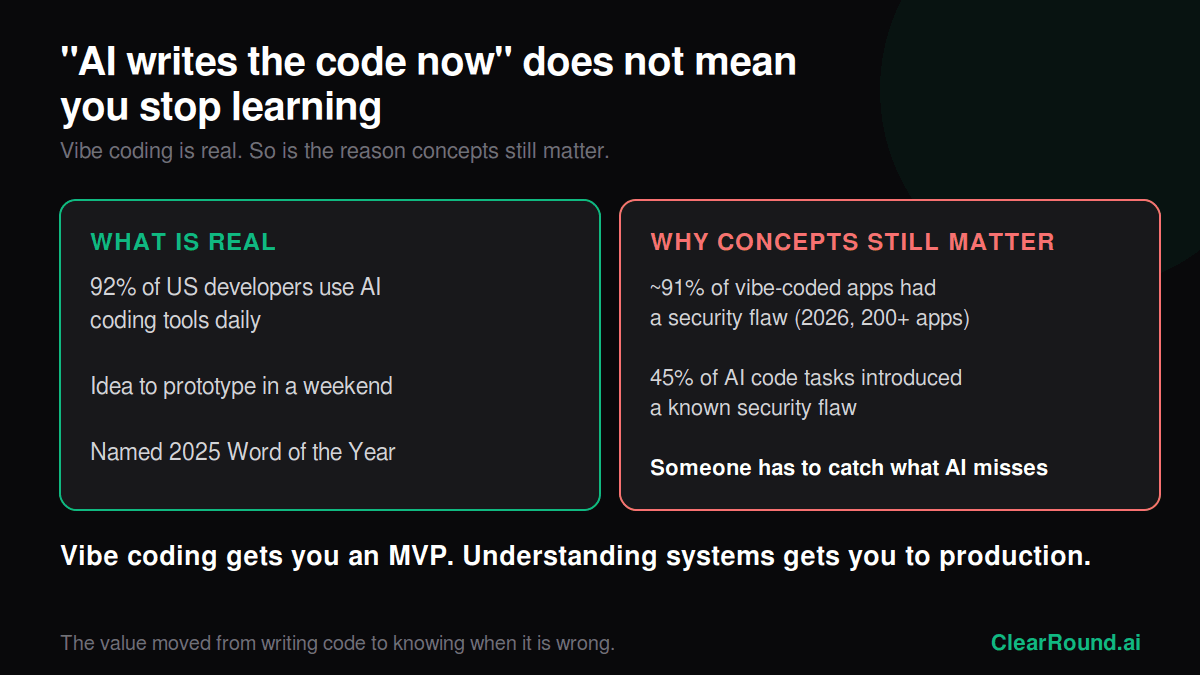
Vibe coding is genuinely emerging. In 2026, 92% of US developers use AI coding tools daily, and Collins Dictionary named "vibe coding" its 2025 Word of the Year. The speed is real. People go from idea to working prototype in a weekend.
But here is what the hype leaves out, and it is backed by hard data, not opinion. A Q1 2026 review of over 200 vibe-coded applications found that around 91% contained at least one security vulnerability traceable to AI making things up. A separate 2026 assessment found that 45% of AI code-generation tasks introduced a known security flaw. The AI does not know what it does not know. It writes plausible code that quietly skips the fundamentals.
So the job did not disappear. It moved. Across the industry, the consensus is that writing code is becoming a smaller part of the work, while system design, architecture, and reviewing what the AI produces are becoming the core skills. As one widely quoted line from the debate puts it: vibe coding gets you an MVP, but engineering gets you to production.
What this means for a fresher: do not read "AI writes the code now" as "you never need to understand anything." The opposite is happening. The people who will struggle are the ones who lean fully on AI without learning the concepts, because they cannot tell when the AI is wrong. The people who will do well understand systems well enough to catch the mistakes. Concepts and design thinking matter more now, not less, whether you write the code yourself or direct AI to.
The two groups of "AI jobs without coding"
With that clear, here is the distinction the hype blurs, and it saves you months of chasing the wrong thing.
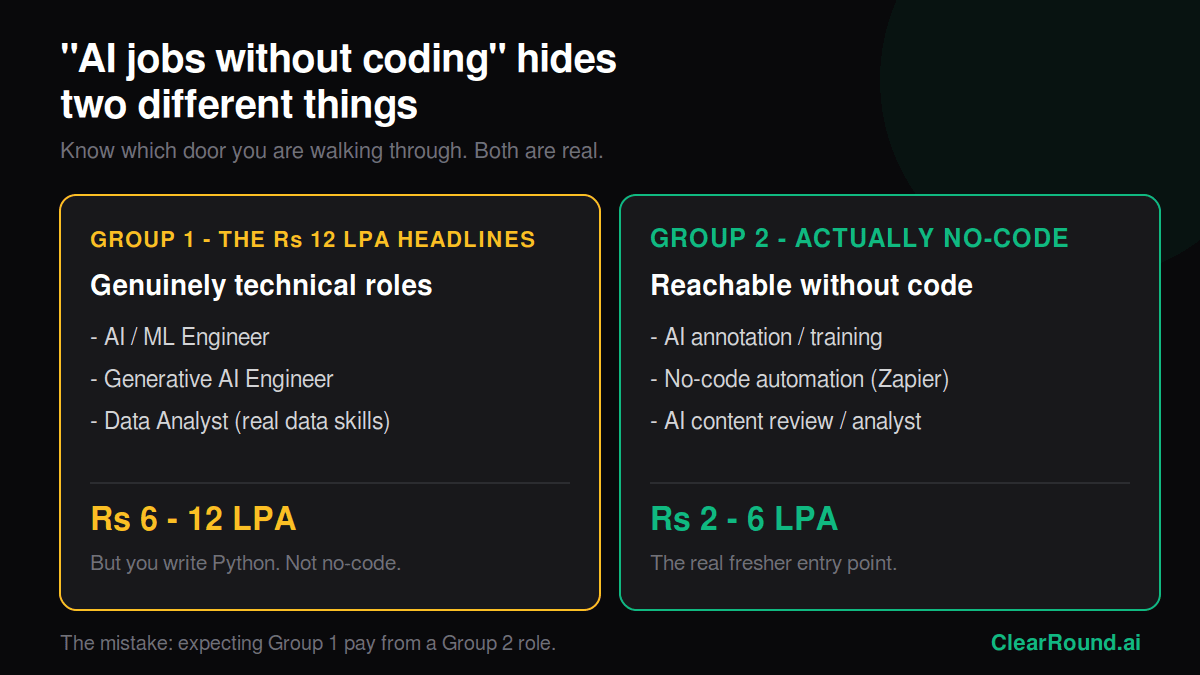
There are two very different groups of AI roles. The first is genuinely technical: AI/ML Engineer, Generative AI Engineer, Data Analyst with real data skills. These are the roles quoted at Rs 6-12 LPA for freshers. They are real and in demand, but they expect you to write Python and understand the fundamentals we just discussed. They are not no-code at all.
The second group is the actually-no-code one: AI data annotation and training, no-code automation, AI content review, AI-assisted analyst work. These are reachable without programming, and they usually start at Rs 2-6 LPA, not Rs 12. When an article promises a no-code AI job at Rs 12 LPA, it has quietly swapped one group for the other.
Neither group is bad. The mistake is expecting group-one pay from a group-two role, getting discouraged, and quitting. Know which door you are walking through.
The real no-code entry points (and what they pay)
These are roles a fresher with no coding can genuinely start in. Honest salary ranges, based on current market data.
| Role | What you actually do | Realistic fresher pay |
|---|---|---|
| AI Trainer / Data Annotator | Label data, review AI outputs, flag errors and bias to improve the model | Rs 2-6 LPA |
| No-code Automation Specialist | Build AI workflows with tools like Zapier, Make, or n8n, connecting apps without code | Rs 3-6 LPA (highest of the no-code roles) |
| AI Content Reviewer / Strategist | Direct and check AI-generated content for accuracy, tone, and bias | Rs 3-6 LPA |
| AI-assisted Analyst | Use AI-powered dashboards to find business insights | Rs 4-8 LPA (some SQL helps) |
| Trust and Safety / Content Moderation | Review flagged content, enforce guidelines, handle edge cases AI cannot judge | Rs 3-6 LPA |
The pattern across all of them: they reward attention to detail, clear thinking, communication, and judgment, rather than code. That is genuinely good news if you are analytical or organised but not a programmer.
Two honest caveats. First, no-code automation is the highest-paying of these, but it is also the most demanding. It needs real logical thinking and comfort mapping how data moves between apps, so the learning curve is steeper than annotation or content work. Second, even these no-code roles reward you for adding a little Python or SQL once you are in. The people who get stuck treat "no code" as "no learning, ever." The people who climb fastest add basic skills after they land the role.
The "prompt engineer" reality check
This one needs saying plainly, because it is the single most over-sold AI job.
In 2026, "prompt engineer" as a standalone fresher title has largely faded. Prompting turned into a skill that many roles now expect, rather than a job by itself. A marketer, an analyst, a support lead, and a writer are all expected to prompt AI well as part of their work. The demand did not vanish, it got absorbed into other roles.
What this means for you: do not build your entire plan around landing a "prompt engineer" job. Build prompting as a skill that makes you stronger in whatever role you target. It is a multiplier, not a destination. Anyone promising a dedicated prompt-engineer salary to a fresher with no other skills is selling you last year's headline.
What actually gets you hired
Here is the part that matters more than the role you pick, and it is the same across every AI job, coding or not.
Proof of work beats certificates. Hiring has shifted hard toward skills-first screening, with employers prioritising demonstrated ability over qualifications alone. A candidate with two or three real, documented projects consistently beats one with five certificates and nothing to show.
So whatever door you choose, generate proof:
- Pick one role from the list above that fits your strengths, instead of chasing all of them.
- Build two or three small, real projects and put them somewhere visible. For automation: a working Zapier or Make workflow that does something useful. For analyst work: a dashboard with real data. For annotation or training: documented work on open datasets, or paid task platforms that double as portfolio.
- Document what you did and why, in plain language. The thinking behind the work is what employers are actually screening for.
- Skip the "wait until I feel ready" trap. Start one project this week. Proof beats readiness.
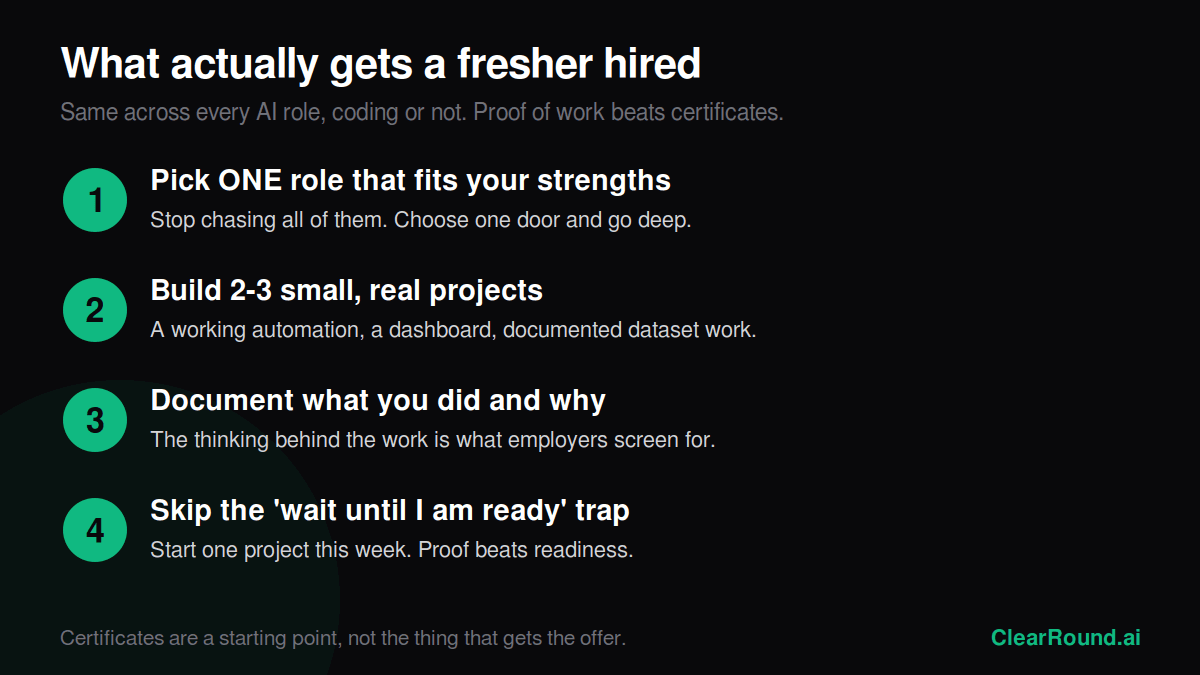
Certificates are fine as a starting point. They are not the thing that gets you the offer. The project is.
If you want to see which roles are most and least exposed to AI before you commit to a path, check any occupation on the AI Job Exposure map, built on India-specific workforce data across 127 occupation groups. It is a useful reality check on where a field is heading.
Whatever role you target, you still have to interview
Here is the step every guide skips, and it is where most offers are actually won or lost.
You can pick the perfect no-code AI role, build the projects, and apply. Then you reach the interview, and none of these roles are tested the way a coding round works. AI annotation, automation, analyst, content review: these are interviewed through conversation. The interviewer asks how you think, how you would handle a messy real situation, and why you made a choice. They are testing your reasoning and communication, out loud, under pressure.
This is the gap that catches freshers. You can know your projects cold and still freeze when asked to explain them. Knowing something and being able to say it clearly are two different skills, and the interview only tests the second one.
That is exactly what ClearRound's voice mock interview is built for. You practise answering out loud, like a real interview, and get scored on five things that decide how you come across: relevance, structure, specificity, communication, and confidence. For a non-coding role, where the whole interview is conversation, those five are the entire game. You find out where you are weak before the real interview, not during it.
The AI job market in India is genuinely opening up for freshers without coding. But it does not hand out roles to anyone who lists the right keywords. It rewards people who understand how things work, pick a real path, prove their skills with projects, and can explain their thinking clearly when it counts. Get those right, and the door is open.
Practice with our AI interviewer
Voice mock interview with scored feedback. Free session.
Start a mock interview →Frequently Asked Questions
Priti
AI interview preparation insights from the ClearRound team.