
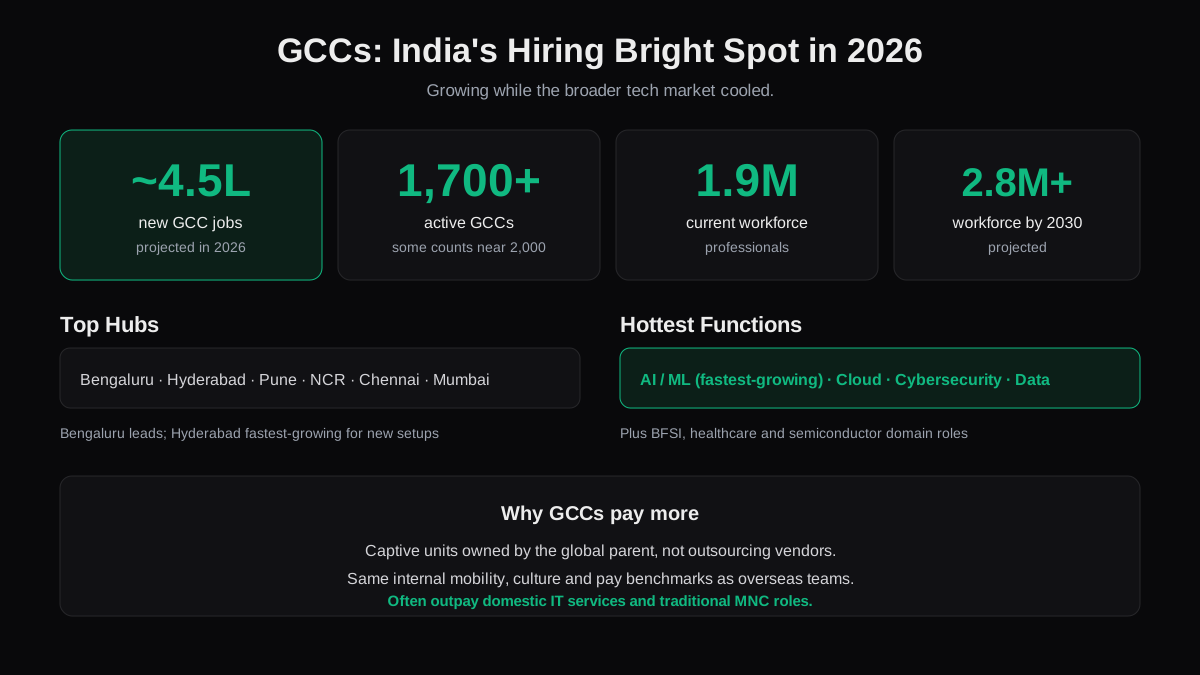
While the broader Indian tech market hit a 28-month low in June 2026, one segment kept its foot on the accelerator. Global Capability Centres, the captive India units of global multinationals, are projected to add around 4.5 lakh new jobs this year, with more than 1,700 centres already running across Bengaluru, Hyderabad, Pune, Gurgaon, Chennai and Mumbai.
If you are job-hunting in a hard market, GCCs deserve the top of your target list. But here is the catch most candidates miss: GCCs do not hire like IT services firms. Many roles are filled through referrals and recruiter outreach before they are ever posted. Applying through job boards alone means you are competing for the leftovers. This guide explains how GCC hiring actually works and how to position yourself to get in.
Quick Facts: GCC Hiring in India 2026
| Signal | Number |
|---|---|
| New GCC jobs projected for 2026 | ~4.5 lakh (NASSCOM) |
| Active GCCs in India | 1,700+ (some counts near 2,000) |
| Current GCC workforce | ~1.9 million professionals |
| Projected workforce by 2030 | 2.8-3.5 million |
| Top hubs | Bengaluru, Hyderabad, Pune, NCR, Chennai, Mumbai |
| Fastest-growing function | AI / ML (demand up sharply since 2024) |
| Typical pay vs domestic IT services | Often higher, closer to global benchmarks |
What a GCC Actually Is (and Why It Pays More)
A GCC is a captive offshore unit, wholly owned by the parent multinational, not a third-party outsourcing vendor. That distinction shapes your whole career. You work directly for the global company, on the same internal mobility paths, culture and compensation benchmarks as its teams in the US, UK or Europe. Many GCC hires eventually rotate to the parent's headquarters.
This is why GCCs have become, for many Indian professionals, the most attractive employment category in the country, often outpaying both domestic IT services and traditional MNC roles. The work has changed too: GCCs moved from back-office support to owning end-to-end products, AI engineering, R&D, cybersecurity, finance transformation and digital product leadership.
The trade-off is selectivity. GCCs hire for global standards on technical depth, communication and stakeholder management. The bottleneck in 2026 is no longer hiring volume; it is finding people who clear that bar. Which is good news if you prepare like it.
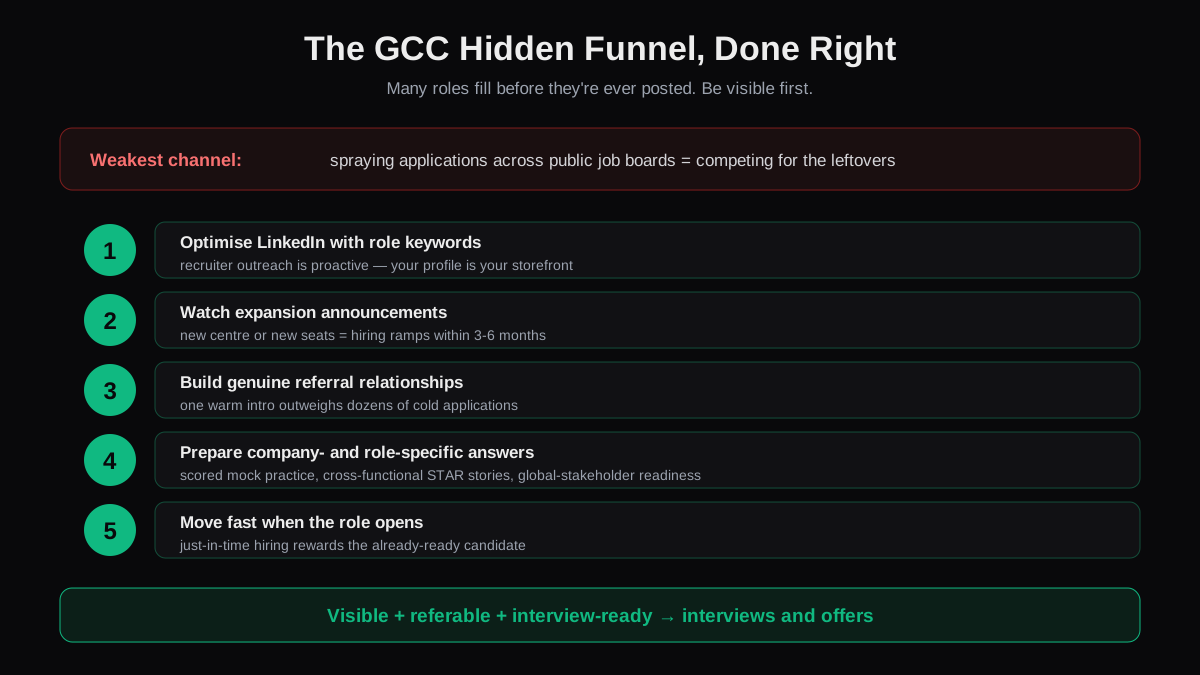
Insider Tip: GCC interviews weight communication and global-stakeholder readiness far more heavily than typical Indian IT-services rounds. You will be asked behavioural questions about working across time zones, handling ambiguous requirements from a remote manager, and disagreeing with a senior stakeholder professionally. Prepare 2-3 STAR stories specifically about cross-functional or cross-cultural collaboration, even if it is from a college project or internship.
The Hidden Funnel: How GCCs Actually Recruit
Here is the single most useful thing to understand about GCC hiring: many roles never reach a public job board, or reach it only after the pipeline is already full. The funnel runs through channels most candidates ignore:
- Recruiter outreach on LinkedIn. GCC talent acquisition is largely proactive. Internal recruiters search for and message candidates directly. A current, keyword-rich LinkedIn profile is not optional; it is your storefront.
- Employee referrals. GCCs weight referrals heavily because their parent-company cultures do. One warm introduction from a current GCC employee can outweigh dozens of cold applications.
- Campus partnerships. Large captives (JPMorgan, Citi, Goldman, Microsoft, Google) run structured programmes at IITs, NITs and BITS, with pipelines starting 12-18 months early.
- Parent-company career pages. Many GCCs list India roles on the global careers site (the parent's own domain) rather than only on Indian job boards.
- Expansion announcements as signals. When a company announces a new centre or a few hundred new seats in a city, hiring typically ramps within 3-6 months, often before roles are posted. Watching expansion news is a way to apply early.
The practical implication: spraying applications across Naukri is the weakest channel. The strongest is being visible and referable before the role goes live.
Insider Tip: Treat a GCC expansion announcement as a starting gun. When you read that a multinational is opening or scaling a centre in your city, identify 3-5 current employees there on LinkedIn, engage genuinely with their content for a couple of weeks, then ask for a short informational chat, not a referral. The referral, if it comes, follows the relationship. Candidates who move in the weeks after an announcement reach recruiters before the public posting crowd arrives.

Where the GCC Jobs Are: Hubs, Sectors, Skills
Demand is concentrated and worth targeting precisely:
- Hubs: Bengaluru leads with the largest share of activity, Hyderabad is the fastest-growing setup destination (especially BFSI and analytics), and Pune, NCR and Chennai are scaling. Tier-2 cities are emerging as lower-cost alternatives.
- Sectors: Technology still has the largest absolute volume (cloud, data, AI, cybersecurity). The fastest growth is in healthcare and life sciences, and BFSI and fintech, where large new centres are setting up. Semiconductors (Chennai, Bengaluru, GIFT City) carry an acute talent shortage and premium pay.
- Skills: AI and machine learning is the single fastest-growing function, with hands-on LLM, NLP and model-optimisation experience commanding a premium. Beyond that: data engineering, cloud architecture, cybersecurity, product engineering, and domain expertise that turns technical skill into business impact.
The common requirement across all of these is demonstrable, current skill over a generic degree. A public repository updated recently, one or two real projects, and clear AI literacy matter more than marks.
If you are weighing which skills to deepen, it is worth a reality check on where AI is heading in your specific role. India's worker-weighted average AI exposure is about 1.9 out of 10, and only 4.5% of workers are in high-exposure jobs, so this is about positioning, not panic. You can look up your occupation on the free AI Job Exposure map before you commit a year to upskilling in one direction.
Your Move: A Practical GCC Job-Search Plan
GCCs reward candidates who are visible, referable and interview-ready before the role appears. One focused week to set that up:
- Day 1: Rewrite your LinkedIn headline and About section with the exact role keywords GCC recruiters search for. Make your profile findable, not just present.
- Day 2: Build a target list of 10-15 GCCs by hub and sector. Follow each on LinkedIn and turn on alerts for their expansion news.
- Day 3: Fix your resume for ATS and tune it to two or three target role types, our ATS-friendly resume format guide covers the structure. Most GCCs still parse resumes through ATS before a human review.
- Days 4-5: One scored voice mock interview per day, focused on a target company and role. Drill cross-functional and stakeholder STAR stories.
- Day 6: Identify 5-10 current employees at your top 3 targets. Start genuine engagement; plan informational chats.
- Day 7: Lock your two power answers: "why this company" and "how fast can I contribute," plus 3 sharp questions to ask the panel.
On day 8 you are not waiting for a posting. You are positioned to move the moment a GCC in your city signals it is hiring.
Practice with our AI interviewer
Voice mock interview with scored feedback. Free session.
Start a mock interview →Frequently Asked Questions
Kanishk
AI interview preparation insights from the ClearRound team.