
The notice is either on your T&P cell's board already or it lands this month: placement season 2026-27 opens in August. And every year, the same thing happens: most of the batch starts preparing when the first company arrives, which is roughly six weeks too late, because of one structural fact almost nobody tells you.
The best companies usually come first. Placement calendars are broadly stacked by package: the highest-paying product companies and top consulting firms tend to recruit in the opening weeks, mass recruiters run through the middle of the season, and the calendar thins toward December. Preparing "as the season goes" means being at your weakest exactly when the strongest opportunities visit, and at your sharpest for the leftovers.
So here's the whole machine explained, and the 8-week plan that has you match-fit for week one.
How a Placement Season Actually Works
The funnel at almost every college runs: pre-placement talk → registration/nomination → online test → technical interview(s) → HR round → offer. A few things inside that funnel that first-timers learn the hard way:
Eligibility gates are enforced coldly. CGPA cutoffs (commonly 6.0 to 7.5 depending on the company), backlog rules, and sometimes 10th/12th percentages. If you're near a boundary, know each target company's criteria now, not on registration day; our company guides list them per firm.
One-offer and dream-company policies shape your strategy. Many colleges freeze you out of further companies once you hold an offer, with a "dream company" exception above a package threshold. Understand your college's exact policy before the season, because it changes whether you should sit for the first decent company or hold, and that's a decision you want to make calmly in August, not tearfully in September.
The PPT is not a formality. Companies mention their process, tracks, bond terms and locations in the pre-placement talk, and interviewers notice who knows this. It's the cheapest research you'll ever get; take notes.
The tests are the biggest filter. Across every company we've researched this year, the automated round eliminates more candidates than all interviews combined, and the patterns differ sharply by company: TCS's NQT, Accenture's game-based cognitive round, Cognizant's SQL-heavy clusters, Wipro's coding-plus-essay format. Generic aptitude prep covers maybe 60% of any of them; the last 40% is company-specific.
GD is dying but not dead. Several major recruiters (Deloitte among them) have dropped group discussions, but they survive at some companies and campuses. Check per company rather than preparing for a round you may never face, or skipping one you will.
The 8-Week Plan
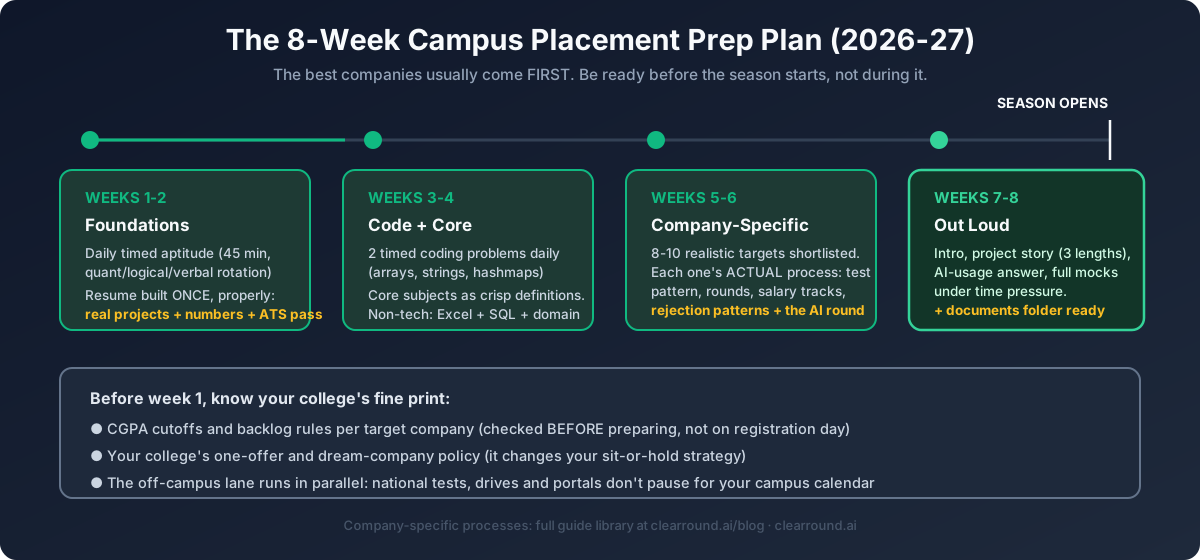
Weeks 1-2: Foundations (aptitude + resume). Daily timed aptitude sets (quant, logical, verbal, 45 minutes, alternating), because every company's test has this core and speed is the differentiator. In parallel, build your resume properly once: real projects with numbers, JD-relevant skills, ATS-clean format. Our fresher resume format guide covers the structure, and one pass through the ATS resume checker will show you what the screening software sees. Do this in week 1, not the night before the first registration, because every application this season reuses it.
Weeks 3-4: Code and core. Tech roles: two timed coding problems daily, arrays, strings, hashmaps, basic sorting, the level every mass-recruiter test actually asks, before anything harder. Plus your branch's core subjects as crisp definitions (OOPs, DBMS, OS for CS; the equivalents for your branch), since technical interviews open with fundamentals. Non-tech roles: Excel properly, SQL basics, and your domain's fundamentals; the Big 4 and analyst pipelines weight exactly these.
Weeks 5-6: Company-specific depth. Shortlist 8-10 realistic targets from your college's expected list, then prepare each one's actual process: test pattern, rounds, salary tracks, known rejection patterns. This is where our company guide library becomes your syllabus: TCS, Infosys, Wipro, Accenture, Cognizant, and the Big 4 compared. Also prepare for the round most of your seniors never faced: the AI-led interview, now standard as an opening stage.
Weeks 7-8: Out loud. The last fortnight is spoken practice, because every decisive round is spoken and silent preparation doesn't transfer. Your introduction (the formulas), your project story in three lengths, your AI-usage answer, and full mock interviews under time pressure. This is precisely what a company-specific mock interview is built for: it reads your own profile and asks about your actual projects and skills, including case questions built from them, which is exactly how campus technical rounds probe. Also this fortnight: documents folder (marksheets, ID, photographs, resume copies), because document chaos on drive day is a self-inflicted wound.
The Five Mistakes That Cost Offers Every Season
1. Starting when the season starts. Covered above; the calendar punishes it structurally.
2. Tunnel vision on one dream company. The healthy structure is a portfolio: 2-3 reach targets, 4-5 realistic ones, 2-3 safety options, each with its process actually studied. And run the off-campus lane in parallel; drives, job portals used correctly, and national tests don't pause for your campus calendar.
3. Preparing silently. Reading answers and saying answers under pressure are different skills. The batch-mates who clear interviews are rarely the ones with the best notes; they're the ones who rehearsed out loud.
4. Ignoring the eligibility fine print. Every season, students discover on registration day that a backlog rule or percentage criterion excludes them from a company they'd prepared weeks for. Read criteria first, prepare second.
5. Treating rejection as a verdict. A placement season is a numbers process with brutal filters, most of which never tell you why (applications routinely go unread, not rejected). The candidates who end the season with offers are usually the ones who kept process quality steady through the first few noes.
Eight weeks from now, the first pre-placement talk of your season will be on the calendar. The batch will split into people scrambling to start and people quietly ready. The entire difference between them is what August was used for.
Practice with our AI interviewer
Voice mock interview with scored feedback. Free session.
Start a mock interview →Frequently Asked Questions
Priti
AI interview preparation insights from the ClearRound team.