
The pitch is everywhere on your feed: an invisible AI overlay that listens to the interviewer and whispers perfect answers onto your screen. Undetectable, they claim. In a market where over 100,000 tech jobs were cut globally in the first five months of 2026, the temptation is real.
Here is what those ads don't show you: the candidates getting disqualified mid-interview, the internal blacklists, and the in-person rounds that Google, Cisco and McKinsey brought back specifically to catch this. The market has split into two camps, live "cheating" copilots and honest prep tools, and only one of them survives contact with a 2026 hiring process. This guide shows you why, with the actual numbers.
Quick Facts: The State of AI Interview Cheating in 2026
| Signal | Number |
|---|---|
| Candidates showing signs of cheating in technical assessments (late 2025) | ~35%, more than double six months earlier |
| Hiring managers who suspect candidates of using AI to misrepresent themselves | 59% |
| Recruiting leaders now using in-person interviews to fight candidate fraud | ~72% (Gartner) |
| Companies that brought back in-person rounds | Google, Cisco, McKinsey, among others |
| Amazon's stated policy | AI tool use in interviews can mean disqualification |
| Tech jobs cut globally, Jan-May 2026 | 100,000+ |
The Cheating Boom Met a Bigger Crackdown
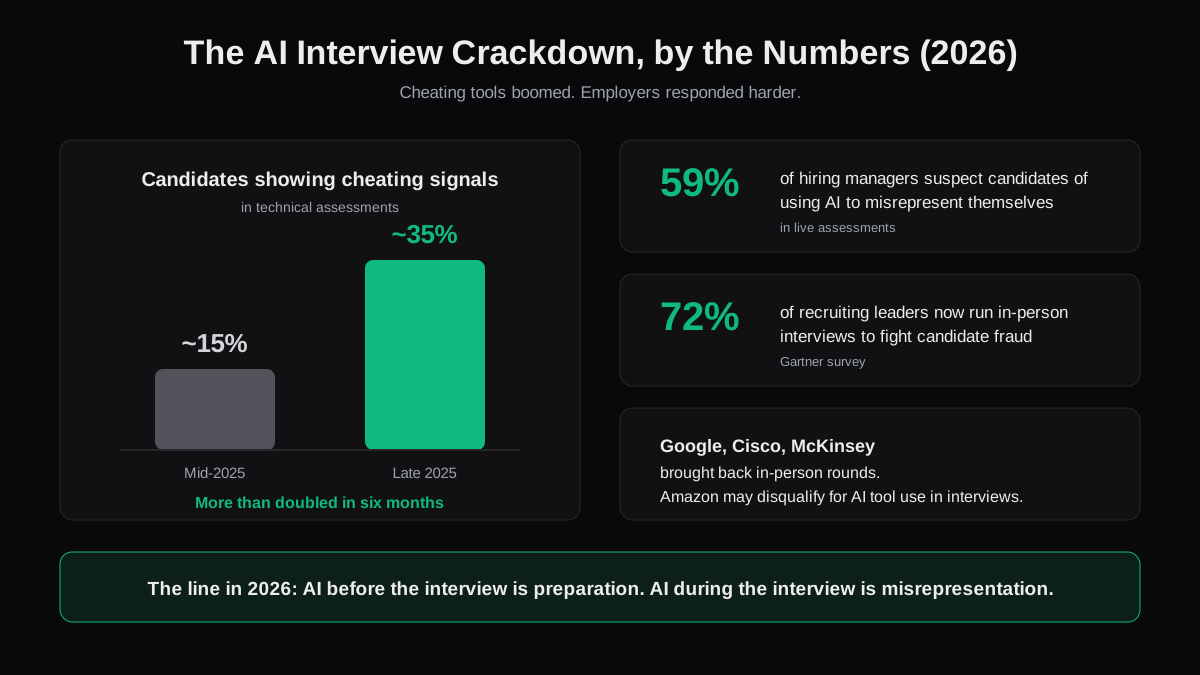
By late 2025, roughly 35% of candidates were showing signs of cheating in technical assessments. That figure had more than doubled in just six months. Tools like Cluely and Interview Coder turned live interview assistance into a subscription product, and word spread fast through developer communities.
Employers noticed faster. Today 59% of hiring managers say they suspect candidates of using AI tools to misrepresent themselves in live assessments. That suspicion changed behaviour on the other side of the table: per Gartner, around 72% of recruiting leaders now run in-person interviews specifically to combat candidate fraud. Google, Cisco and McKinsey all reinstated face-to-face rounds. Amazon has told candidates outright that using AI tools during interviews can get them disqualified.
Read that sequence carefully. The "undetectable" tools did not beat the system. They made the system paranoid, and the system responded by removing the screen entirely. An overlay cannot whisper answers to you across a conference table in Bangalore.
Insider Tip: When a recruiter suddenly adds an "additional onsite discussion" after you aced two virtual rounds, it is often a fraud check, not a formality. They are re-asking variations of questions you already answered to see if the depth holds up without a screen between you. If your virtual answers were genuinely yours, this round is easy. If they weren't, this is where offers die.
How Recruiters Actually Catch the "Undetectable" Tools
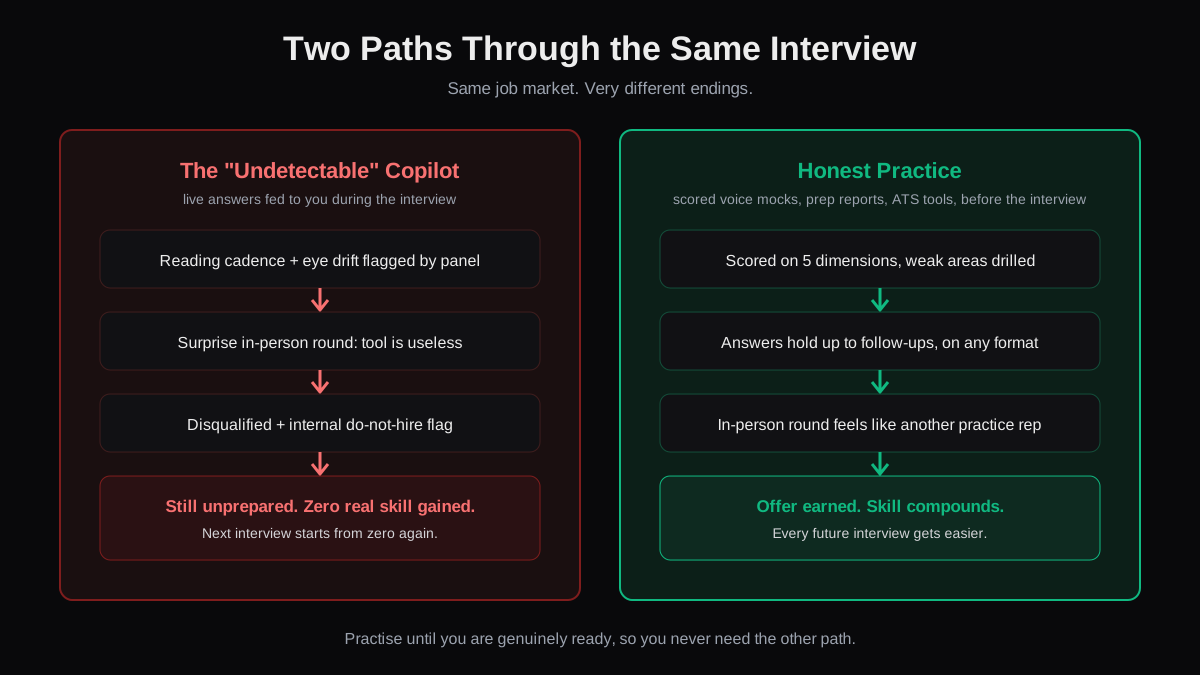
The detection doesn't rely on screen-recording software. It relies on you. Interviewers are trained to spot a cluster of tells that live-answer tools produce almost unavoidably:
- Latency and cadence. A 2-3 second pause before every answer, followed by fluent, structured delivery, is a reading pattern, not a thinking pattern. Humans who think out loud start messy and sharpen as they go.
- Eye drift. Even overlay tools that sit near the camera produce micro-shifts in gaze that experienced interviewers clock within minutes.
- Depth mismatch. The killer question is the follow-up: "Why did you choose that approach over the alternative?" Generated answers are wide and shallow. Real experience is narrow and deep. One probing follow-up exposes the gap.
- Cross-round inconsistency. Your brilliant virtual technical round gets compared against your in-person managerial round. If the same person seems to have lost 40 IQ points, the panel knows why.
- Behavioural analysis in the interview platform itself. Many assessment platforms now flag suspicious patterns automatically. The proctoring arms race moved from "detect the tab switch" to "detect the human who isn't really answering."
And the consequence is not just a rejection email. Companies maintain internal do-not-hire lists, and a fraud flag can block you from re-applying for years. In India's IT services ecosystem, where background verification vendors serve multiple employers, a misrepresentation flag can travel beyond the one company that caught you.
Insider Tip: Recruiters at large Indian IT firms increasingly ask one deliberately simple question early in technical rounds, something a fresher should answer instantly. A long pause on an easy question is a stronger cheating signal than a long pause on a hard one. Interviewers know this and use it.
The Cost Nobody Mentions: You Stay Unprepared
Suppose you are never caught. You still lose, and here is the uncomfortable maths of it.
The job market that makes cheating tempting is the same market that makes cheating useless. With 100,000+ tech roles cut in five months and AI restructuring hitting routine work hardest, the candidates surviving are the ones with demonstrable, durable skill. If a tool answered your interview questions, you now hold a job you cannot do, in a market actively shedding people who cannot do their jobs. The probation period becomes the interview you didn't prepare for, with your salary on the line instead of an offer.
There is a second cost: every hour spent configuring an overlay and rehearsing how to read it naturally is an hour you did not spend becoming the person who doesn't need it. Interview skill compounds. Fifteen mock interviews make the sixteenth real one feel routine. A cheating tool gives you zero reps. You finish the process exactly as nervous and exactly as weak as you started.
If part of the anxiety driving this is "AI is coming for my role anyway, so why play fair", it's worth checking the actual data. India's worker-weighted average AI exposure is about 1.9 out of 10, and only 4.5% of workers are in high-exposure jobs. You can look up your own occupation on the free AI Job Exposure map and see where you genuinely stand, rather than panicking on vibes.
What Honest AI Prep Looks Like (and Why It Wins)
Here is the line that matters in 2026: AI before the interview is preparation. AI during the interview is misrepresentation. Recruiters themselves draw it exactly there, which is why tools framed as practice and coaching sit on the safe side of the scrutiny while "undetectable assistant" tools attract it.

ClearRound is built entirely on the prep side of that line, deliberately. There is no live copilot, no in-interview assistance, no real-time answer feed. That feature does not exist in the product, and we think building it would be doing candidates harm. What does exist is the boring, effective thing:
- Voice mock interviews that are company-specific and role-aware. You answer out loud, like the real thing, and every answer is scored across 5 dimensions: Relevance, Structure, Specificity, Communication and Confidence. The session adapts, probing again when an answer is evasive, the way a real interviewer would.
- Prep Reports with 15 predicted questions for your target company and role, with model answers to study before the interview, not during it.
- Resume and ATS tools, including scoring against 7 real ATS systems and requirements mapped for 57 companies, so you actually reach the interview honestly in the first place.
The pitch is simple: practise until you are genuinely ready, so the thought of needing a hidden tool becomes absurd. That readiness survives in-person rounds, survives follow-up questions, survives probation, and survives the next interview after that. No subscription to a stealth overlay can claim any of those.
Insider Tip: Record yourself answering "tell me about yourself" today, before any practice, and keep the file. After ten scored mock sessions, record it again. The difference in structure and confidence is usually dramatic, and it is the most motivating evidence you can give yourself that practice, not assistance, is what moves your outcomes.
If You're Tempted, Do This Instead
A practical seven-day swap for the time and money a cheating tool would have taken:
- Day 1: Run your resume through an ATS check and fix the gaps. Most rejections happen before any human sees you.
- Day 2: Pull the interview pattern for your target company. Indian IT majors are predictable: rounds, question styles and rejection reasons repeat.
- Days 3-5: One voice mock interview per day. Out loud, scored, weak dimensions noted. Re-drill the weakest dimension the next day.
- Day 6: Prepare 5 STAR stories covering conflict, failure, leadership, delivery pressure and learning. Nearly every behavioural question maps to one of these.
- Day 7: Rapid revision: your must-mention points, your opener, and 3 questions to ask the panel.
Seven days of this beats any overlay, because on day 8 the skill is yours, on camera, in person, and in the job.
Practice with our AI interviewer
Voice mock interview with scored feedback. Free session.
Start a mock interview →Frequently Asked Questions
Priti
AI interview preparation insights from the ClearRound team.