At some point in the last two years, without any announcement, the first interviewer most Indian freshers meet stopped being human.
You've already seen it in this blog's company guides without the label: Accenture's first stage is an AI-graded audio assessment with no human evaluator. PwC's third stage is a pre-recorded video interview where questions appear on screen and you answer to a camera. Versant-style spoken-English tests gate client-facing tracks at Deloitte and across BPO hiring. And beyond the big pipelines, startups and GCCs increasingly run standalone AI video screens as round one.
This guide is about that round: the formats you'll actually meet in India, what the AI genuinely scores (and the mythology about what it doesn't), why prepared candidates still fail it, and how to practise for an interviewer that never nods.
The Four Formats You'll Meet
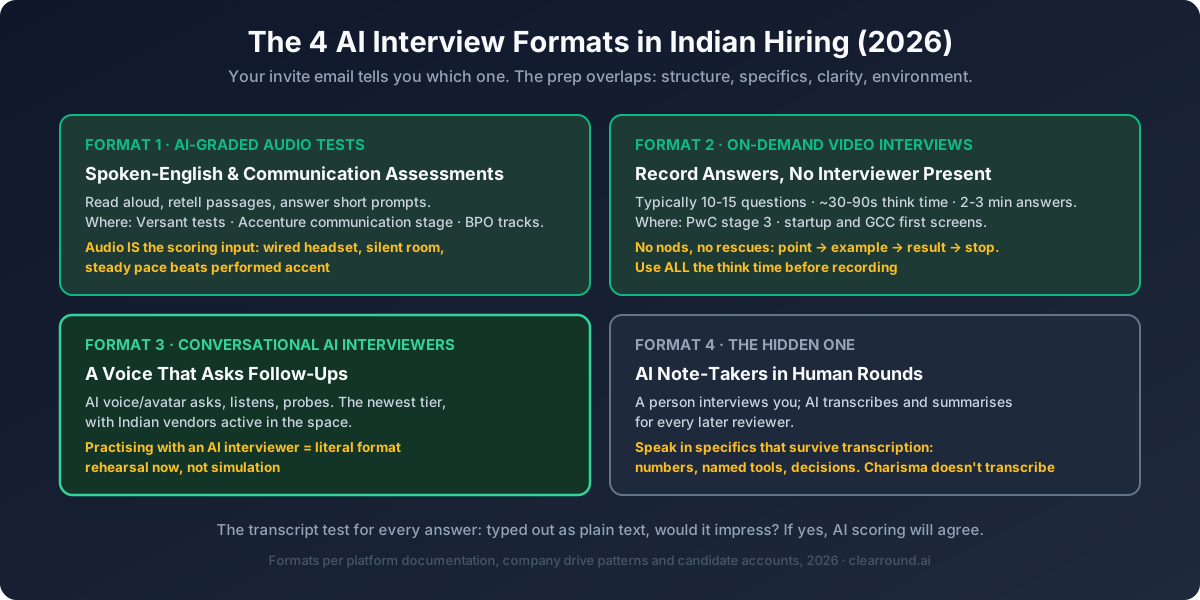
1. AI-graded audio tests. Spoken-English and communication assessments: you read sentences, retell passages, answer short open prompts, and software scores fluency, pronunciation, sentence mastery and comprehension. Versant is the best-known brand; Accenture's communication stage works the same way. No human hears you unless you clear.
2. On-demand video interviews. The PwC-style format, now widespread: typically 10 to 15 questions, roughly 30 to 90 seconds of thinking time and 2 to 3 minutes to record each answer. No interviewer is present; recruiters and/or AI scoring review the recordings later.
3. Conversational AI interviewers. The newest tier: a voice or avatar that asks questions, listens, and asks follow-ups. Indian vendors are active here (InCruiter, for instance, is an Indian company in this space), and reported adoption of video interviewing in early screening stages is near-universal among large employers.
4. The hidden format: AI in the human round. Even when a person interviews you, an AI note-taker increasingly transcribes and summarises the conversation for later reviewers. Practical consequence: answers that survive transcription (specific examples, numbers, named tools) travel well through the process; vibes and charisma don't transcribe.
What the AI Actually Scores (Honestly)
Cut through the mythology, because there's a lot of it:
It scores your verbal content first. Relevance to the question asked, structure, specificity, and clarity of delivery. The platforms themselves are increasingly explicit about this, and the most useful mental model going around is the transcript test: if someone typed out your answer and showed only the text to a hiring manager, would it impress? If yes, you'll generally do well with AI scoring. If no, no amount of camera charisma rescues it.
The facial-analysis fear is mostly outdated. Some early systems did analyse expressions and tone; most vendors have moved away from that due to bias concerns and weak validity. You should still light your face and look at the camera, because a human reviews recordings downstream, but the algorithm's weight sits on what you say, not your micro-expressions.
Audio quality is scoring input, not decoration. For AI-graded audio especially, background noise and clipped microphones register as unclear speech. The same rule we flagged in the Accenture guide applies everywhere: wired headset, silent room, steady pace. And the environment numbers say candidates still lose here on logistics: surveys have found roughly 39% of candidates hitting technical issues in video interviews and 28% admitting they never tested their setup.
One honest acknowledgement: surveys find only around a quarter of candidates trust AI to evaluate them fairly, and the discomfort is legitimate; you're entitled to it. But strategically, the fairness debate changes nothing about your prep: the inputs you control (structure, specifics, clarity, environment) are exactly the inputs any evaluator, silicon or human, rewards. Optimise what you control.
Why Prepared Candidates Fail This Round
Four failure patterns come up again and again in candidate accounts, and none of them are about knowledge:
1. No feedback loop mid-answer. A human interviewer nods, redirects, rescues a rambling answer with a follow-up. The AI round gives you nothing: no signals, no second chances within an answer. Candidates calibrated to human reactions drift, pad, and circle. The fix is structural discipline: point, example, result, stop. We've written before about why 93% of people experience interview anxiety, and the silent format amplifies exactly that.
2. Treating it as the "easy" round. Because no human is watching, candidates prepare less, then get filtered before any human ever sees them. Every automated gate in our company-guide research shows the same pattern: the algorithmic stage rejects more candidates than the interviews that follow it.
3. Answers that don't survive transcription. "I'm a quick learner and team player" transcribes to nothing. "I built the fest website, around 2,000 visitors, and fixed the payment page crash the night before" transcribes to a candidate. Under AI evaluation, the same specificity rules that beat AI-resume sameness decide spoken answers too.
4. The restart spiral. Against a clock with no human patience to appeal to, one stumble triggers a restart, which burns time, which triggers panic. Practising the answer-to-a-clock rhythm beforehand is the only known cure.
The Prep Protocol
One week out: know your format (the invite email tells you: audio test, on-demand video, or live AI), and build 6 to 8 core answers using your real projects: introduction (the formulas), a project deep-dive, a failure story, a teamwork story, why-this-company, and your AI-usage answer, which AI-led rounds ask with pleasing irony.
Practice out loud, timed, to a machine. This is the round where practising with an AI interviewer stops being a simulation and becomes literal format rehearsal: a voice mock interview recreates the exact conditions, speaking structured answers to a clock with no human feedback, and scores the transcript-test dimensions (relevance, structure, specificity, communication) that AI screeners weigh. Record yourself on your phone as the minimum version; hearing your own padding is the fastest cure for it.
Day before: the tech ritual: wired headset, charged laptop, stable connection tested, front-facing light, quiet room booked (family briefed, which in Indian homes is a genuine logistics step, not a joke). Fifteen minutes before: full setup re-check.
During: use the thinking time fully before recording, answer the question asked (AI scoring punishes generic drift harder than humans do), land your specifics early, and stop when the answer is done. Silence after a complete answer costs nothing; padding costs relevance.
And the line we hold everywhere on this blog: prepare with AI, never perform with it. Real-time answer-feeding tools in live interviews are a trap that ends in disqualification, and against AI-led rounds specifically, scripted-sounding delivery is precisely what pattern-scoring flags. The candidates who clear this round aren't the ones who outsmarted the algorithm; they're the ones who practised until structure under time pressure became natural.
The interviewer changed. The skill didn't: knowing your material, saying it in order, proving it with specifics, and stopping. The only real difference is that there's no longer anyone on the other side to save you from an unpractised answer, which makes the practice itself the whole game.
Practice with our AI interviewer
Voice mock interview with scored feedback. Free session.
Start a mock interview →Frequently Asked Questions
Priti
AI interview preparation insights from the ClearRound team.