
A recruiter posted a story recently that sums up interviews in 2026: a candidate answered every question with perfect grammar, glassy eyes, and zero follow-ups. He was reading AI-generated answers off a second screen. He did not get the job, and stories like his are exactly why a new set of questions has entered the standard interview script.
Companies now ask about AI directly. Not machine learning theory, but working questions: what you use, how you check it, where you draw lines. A Gartner survey of 3,290 candidates found 39% had already used AI somewhere in the application process, so interviewers stopped wondering whether you use it and started testing how well.
Here are the 25 questions that keep appearing, grouped into the five categories they come from, with what each category is really testing and how to answer it. We covered the single most common one, "how do you use AI in your work?", in its own guide with a full answer framework. This post gives you the rest of the set.
The 25 Questions, By Category
Category 1: Usage (do you actually use this?)
- How do you use AI in your day-to-day work?
- Which AI tools have you used, and for what?
- Walk me through a task you completed faster because of AI.
- Have you used AI to automate or simplify a manual process?
- Tell me about something you built or produced with AI help.
These are opening questions, and the trap is answering with a tool list. "I've used ChatGPT, Gemini and Copilot" tells the interviewer nothing. One tool plus one task plus one result tells them everything: "I use ChatGPT to draft test cases from requirements docs; it gets me 70% of the way and I write the edge cases myself."
The interviewer wants evidence of a workflow, so speak in workflows, not logos. Freshers can draw from college projects and placement prep. Using AI to prepare for interviews is itself a legitimate answer, and it has the advantage of being verifiable in the room.
Category 2: Verification (who catches the mistakes?)
- How do you verify AI output before you rely on it?
- You've used AI to write a summary for a client. What do you check before sending it?
- How do you know when an AI answer is wrong?
- What kinds of tasks does AI do badly?
- Have you ever caught AI making an error that mattered?
This category decides more offers than any other. Every hiring manager has seen confident, wrong AI output, so a candidate with no verification habit reads as a risk. The answer must be a method, in concrete steps: run the code against edge cases, check claims against the source document, cross-check numbers with the actual data, read the draft aloud and cut anything you cannot personally stand behind.
"I review it carefully" fails. It describes a mood, and the follow-up will expose it.
Category 3: Boundaries, Data and Ethics (can we trust you?)
- When would you NOT use AI?
- Would you paste confidential company data into ChatGPT?
- How do you decide what is safe to share with an AI tool?
- Is it ethical to use AI for [task in your field]? Where is the line?
- Should you disclose AI use to a client or manager?
Question 12 looks like a trick. It is a trust test, and companies started asking it after real incidents of employees pasting internal financials and source code into public chatbots. The right answer describes personal guardrails: separate workflows for public and confidential material, stripping identifying details before prompting, using only company-approved tools for client data.
For question 11, have a clear line ready. Confidential data. Final calls with legal or financial weight. Work where the thinking is the deliverable. And one more that earns respect: anything you would not be able to explain afterwards.
Category 4: Failure and Learning (are you honest about it?)
- Tell me about a time AI got something wrong for you.
- What did you change in your process after AI made a mistake?
- Have you ever over-relied on AI? What happened?
- What's the most useful AI tool you've learned in the past six months?
- How do you keep up as these tools change?
If you have used AI for more than a week, you have a failure story. Tell it plainly: what it got wrong, what it cost, what you changed. A candidate with no failure story is claiming either that they barely use AI or that they never check it, and interviewers know both are bad.
Question 19 is quietly a curiosity test. "I tried [tool] last month for [task], kept it for X, dropped it for Y" beats any rehearsed enthusiasm about the future of technology.
Category 5: Role and Future (have you thought about this at all?)
- How do you think AI will change this role in the next two years?
- Which parts of your work should stay human? Why?
- If we gave you an AI tool for [core job task] tomorrow, what would you do with it?
- How would you bring a sceptical teammate along on using AI?
- Where does AI give you an edge, and where does it add risk, in this job?
No one expects a prediction. They expect a point of view, and "I haven't really thought about it" is the only failing answer in this category. A workable position for almost any role: AI compresses the production work, which moves the value to judgment, taste, and knowing what to ask for. Then make it specific to the job in front of you.
If you want the macro picture behind your answer, our AI Job Exposure tool maps how exposed 127 occupation groups across India actually are, built on public labour data. Ten minutes with your own occupation's score gives you material no rehearsed answer can match. And if your interest in this goes beyond one answer, we've mapped the AI jobs that don't need coding too.
The Pattern in Every Strong Answer
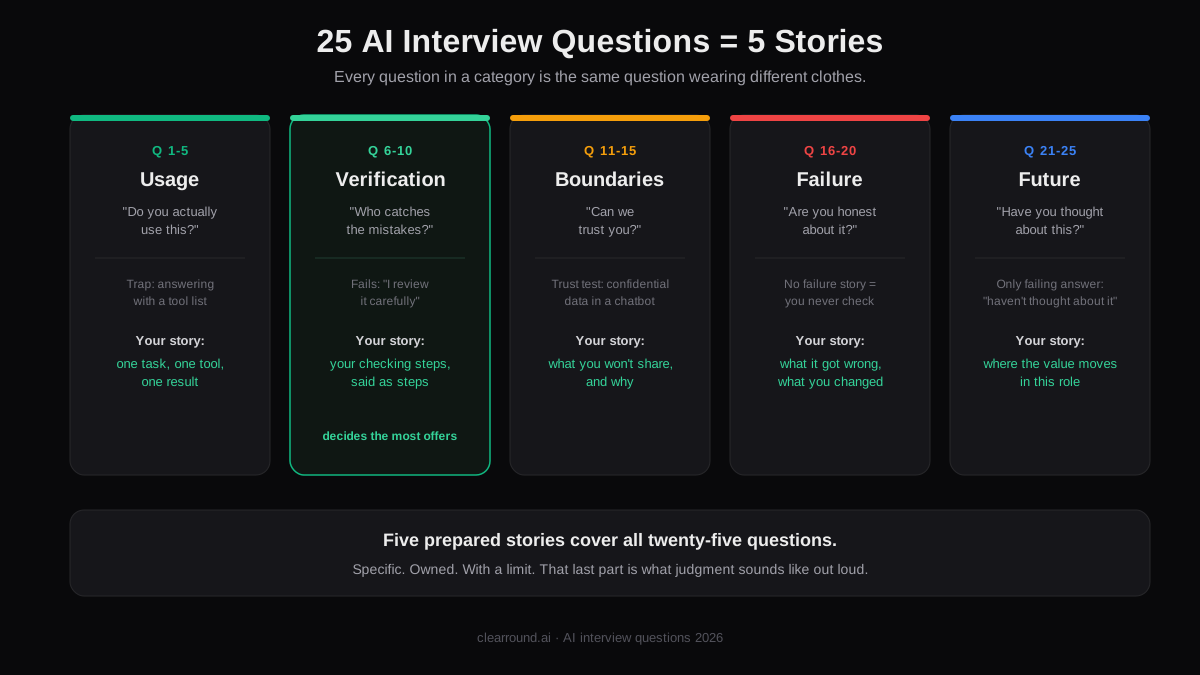
Read the five categories again and one shape repeats. Strong answers are specific (one task, one tool, one number), they are owned (you checked, you decided, you shipped), and they include a limit (something AI gets wrong, somewhere you will not use it).
That third part surprises people. Candidates assume enthusiasm wins, so they polish answers about AI being transformative. But interviewers are screening for the opposite failure now: over-reliance. The candidate who says "it's wrong about one time in five, which is why my cross-check step is non-negotiable" outscores the candidate who says AI changed their life. Limits are what judgment sounds like out loud.
One boundary worth stating because interviewers now probe for it: using AI to prepare is fine and increasingly expected; using AI to answer live is the fastest way to lose an offer. Recruiters describe the script-reader as a recognisable type: the eye drift, the flat pacing, the perfect grammar with no personality. We wrote about why those live-answer tools are a trap, and the short version is that interviewers can tell, and the moment they suspect it, the interview is over regardless of your answers.
How to Prepare All 25 Without Memorising 25 Answers
You do not need 25 scripts. You need five stories, one per category:
- A usage story: one task, one tool, one result.
- A verification method: your actual checking steps, said as steps.
- A boundary: what you will not put into AI, and why.
- A failure: what AI got wrong, and what you changed.
- A position: how AI moves the value in this specific role.
Five stories cover all 25 questions, because every question in a category is the same question wearing different clothes. Write each story in four or five lines. Then, and this is the part most people skip, say them out loud under pressure, because a story that reads well and a story you can deliver while being watched are different things.
A mock interview is the fastest way to pressure-test all five: ClearRound's AI interviewer asks these questions with follow-ups the way a real panel does, and scores your answers on structure, specificity and confidence. The first mock is free, so you can find out which of your five stories collapses under questioning before an interviewer does.
Interviewers are not looking for an AI expert. They are looking for someone who uses the tools, checks the output, knows the limits, and has thought about what comes next. Five honest stories prove all four.
Practice with our AI interviewer
Voice mock interview with scored feedback. Free session.
Start a mock interview →Frequently Asked Questions
Priti
AI interview preparation insights from the ClearRound team.