
In January 2026, TCS told analysts it had 217,000 employees with what it calls higher-order AI skills, up from 180,000 barely a month earlier. Its COO said the freshers it wants are the ones who treat AI as a teammate. Around the same time, industry analysis found AI requirements in roughly 74% of new IT contracts.
That is the backdrop for a question that has quietly become standard in Indian interviews: "How do you use AI in your work?"
It sounds casual. It is not. Recruiters use it to sort candidates into three buckets in under a minute, and two of those buckets get rejected. This guide covers what the question is really testing, the two answers that fail, a four-part structure that works, and sample answers you can adapt whether you are a fresher or five years in.
Why Interviewers Ask This Now
Three things changed between 2024 and 2026.
First, AI stopped being a specialist skill. When AI shows up in three out of four new IT contracts, every project role touches it. A hiring manager staffing a client project needs people who can work with these tools from week one, because the client is paying for exactly that.
Second, the pay gap became measurable. LinkedIn India data from January 2026 put the salary premium for AI skills at around 56%. Companies are not paying that premium for people who list "ChatGPT" under skills. They are paying for judgment: knowing what to hand to a model and what to keep.
Third, hiring itself got tighter. Indian IT's fresher intake shrank while AI hiring grew, projected at around 32% growth in 2026. Fewer seats, and the seats that exist lean AI. So the question does double duty: it screens for a skill and it screens for attitude. Someone defensive about AI in 2026 looks like someone who will be defensive about the next change too.
One more thing worth knowing. The question is no longer limited to tech roles. Marketing, HR, finance, operations, sales: if the job involves a laptop, assume the question is coming. If those are the roles you're targeting, our guide to AI jobs that don't need coding maps where the openings actually are.
The Two Answers That Fail
Interviewers hear the same two bad answers all day.
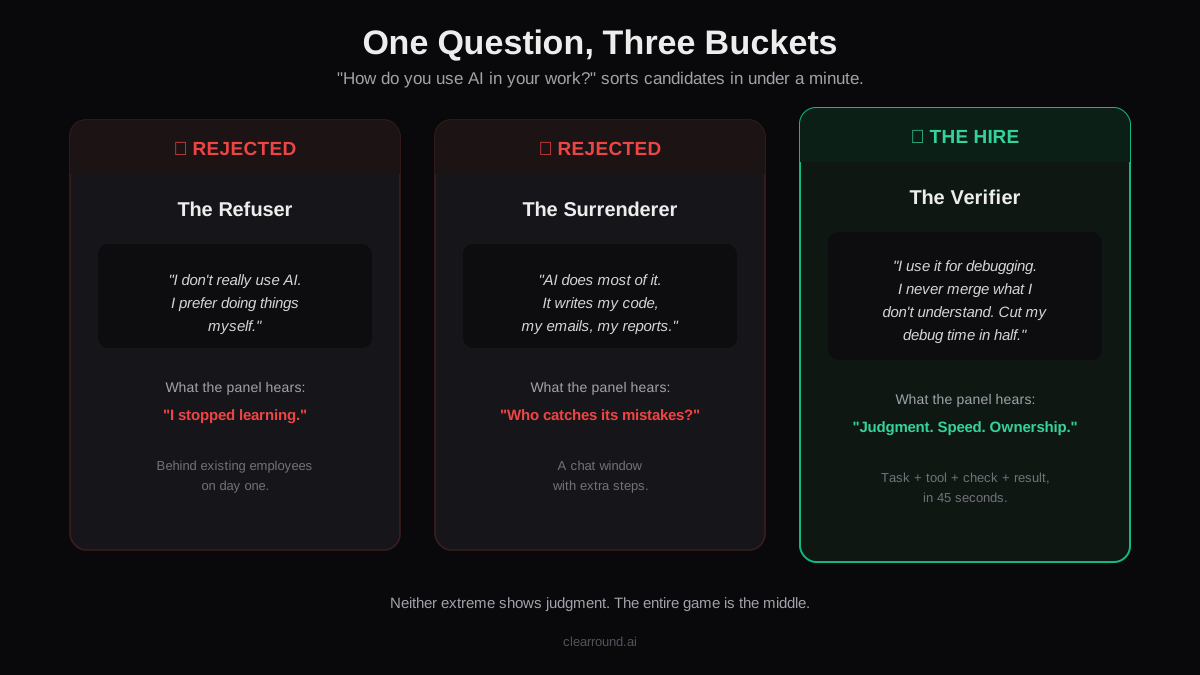
Wrong answer #1: "I don't really use AI. I prefer doing things myself."
Candidates say this thinking it signals integrity and strong fundamentals. What the interviewer hears is different: this person has not touched the biggest shift in how work gets done since the spreadsheet. In a company that just spent a year training its workforce on AI tools, "I don't use it" places you behind their existing employees on day one.
There is a variant that fails for the same reason: "I know about AI but I haven't needed it yet." Need was never the point. Curiosity was.
Wrong answer #2: "AI does most of it. It writes my code, my emails, my reports."
This one fails in the opposite direction. The interviewer now suspects that hiring you means hiring a chat window with extra steps. Worse, it raises a quality question: if AI does the work, who catches its mistakes? Every experienced interviewer has seen confident, wrong AI output. A candidate who cannot describe how they verify anything is a liability on a client project, not a productivity win.
Notice what both wrong answers have in common. Neither shows judgment. One refuses the tool, the other surrenders to it. The entire game is the middle.
The Framework: Task, Tool, Check, Result
A strong answer has four beats. It takes about 45 seconds to say.
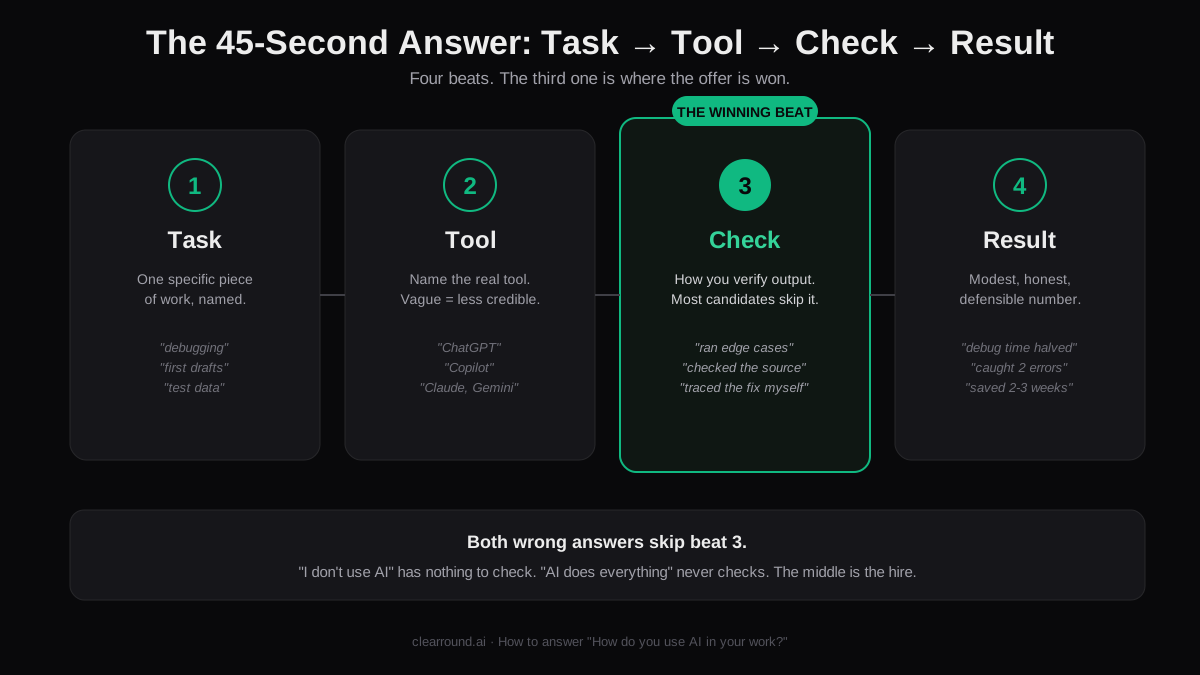
1. Task. Start with one specific piece of work. Not "I use AI for productivity." One task: debugging, drafting test cases, summarising research calls, first drafts of campaign copy. Specificity is what separates a real user from someone who read a listicle.
2. Tool. Name it. ChatGPT, Claude, Copilot, Gemini, whatever you actually used. Naming real tools costs nothing and adds credibility. Vague phrases like "various AI solutions" subtract it.
3. Check. This is the beat that wins the answer, and the one most candidates skip. Say how you verify the output. You ran the code against edge cases. You checked the summary against the source document. You rewrote the draft in your own voice and cut the claims you couldn't stand behind. The check is where your judgment lives, and judgment is what they are hiring.
4. Result. Close with what changed. Time saved, errors caught, more iterations shipped. Keep the number honest and small if it has to be. "It cut my debugging time roughly in half" beats an inflated claim you will be asked to defend.
Here is the framework assembled, for a developer:
"I use Copilot and ChatGPT mostly for debugging and boilerplate. Last month I had a race condition that would have taken me a day to isolate; I walked ChatGPT through the symptoms, it suggested three candidate causes, and the second one was right. I never merge anything I don't understand though, so I traced the fix manually and added a test for it. Overall it's cut my debugging time by maybe half, and I spend the saved time on design."
Task, tool, check, result. Forty seconds. It names real tools, shows a real habit of verification, and ends on a believable outcome.
Sample Answers by Situation
Fresher with no work experience. You still have material: college projects, internships, placement prep itself.
"I haven't worked professionally yet, but I used AI heavily in my final-year project. I used ChatGPT to understand parts of the Django documentation faster and to generate test data. I learned quickly that I couldn't trust it blindly; it once gave me a deprecated method, and after that I started checking its suggestions against the official docs. It probably saved me two or three weeks across the project."
The deprecated-method detail is doing the heavy lifting there. A small story about AI being wrong, and you catching it, is worth more than any claim about AI being amazing.
Marketing or content role.
"I use ChatGPT for first drafts and variant testing, ten subject lines instead of three. The drafts are never final; I rewrite for our brand voice and I fact-check anything that sounds like a statistic, because models invent numbers with total confidence. The win is iteration speed. I test more versions than I could write from scratch."
Data or analyst role.
"Mostly for writing SQL faster and explaining unfamiliar code. I paste in a query, ask what it does, and cross-check against a sample of the actual data before I rely on it. It's wrong maybe one time in five, which is exactly why the cross-check step is non-negotiable for me."
Saying the tool is wrong one time in five sounds like a confession. It is actually the strongest sentence in the answer. It proves you measure.
The Follow-Up Questions (Prepare These Too)
Good interviewers do not stop at the first answer. Three follow-ups come up again and again.
"When would you NOT use AI?" Have a clear line. Anything involving confidential client data. Final decisions on anything with legal or financial weight. Work where the thinking is the deliverable, like an architecture decision you need to be able to defend for the next two years. This is one of a whole family of questions panels now draw from; we've mapped all of them in 25 AI interview questions to prepare for.
"Tell me about a time AI got something wrong." If you have used these tools for more than a week, you have a story. Tell it plainly and end with what you changed about your process. No story at all suggests you either barely use AI or never check it. Both are bad.
"How do you verify AI output?" Concrete beats abstract: run the code, check the source, test against known data, ask a second model and compare. "I review it carefully" is not a method.
These follow-ups exist because the first answer is easy to rehearse. The follow-ups are where rehearsed candidates run out of script, which is exactly why you should prepare honest material for them instead of a script. Pair this with a tight opening for "tell me about yourself" and you have covered the two questions almost every panel now starts with.
How to Practise This Answer
Reading a framework and delivering it under pressure are different skills, a gap we unpacked in why mock interviews matter. The question feels easy until an interviewer is watching you, and then "Task, Tool, Check, Result" turns into a three-minute ramble about ChatGPT being useful.

Three ways to close that gap:
Write your four beats down first, one line each. If any beat is blank, you have found the hole to fix before the interview, and it is usually the Check.
Say it out loud, timed. Under a minute. Recording yourself on a phone works. Most people discover they bury the result at the end of a ramble instead of landing on it.
Pressure-test it with follow-ups. This is hard to do alone, which is where a mock interview helps: ClearRound's AI interviewer asks the question, pushes follow-ups the way a real panel does, and scores your answer on structure, specificity and confidence, so you can see whether your Check beat actually landed or got lost. The first mock is free.
Since this question is really about proving you can work alongside AI, it is also worth knowing where your role itself is heading. Our AI Job Exposure tool maps that for 127 occupation groups across India, free.
A last thought. This question is one of the few in an interview where the honest answer and the winning answer are the same thing. You do not need to have automated anything impressive. You need one real task, one real tool, one real habit of checking, and one modest result. If you have those four things, you are already ahead of both wrong answers, and most of the field.
Practice with our AI interviewer
Voice mock interview with scored feedback. Free session.
Start a mock interview →Frequently Asked Questions
Priti
AI interview preparation insights from the ClearRound team.