Here's the uncomfortable math of applying for jobs in 2026: recruiters in Bengaluru report that 65 to 70% of the resumes they receive are AI-generated. Applications per open role in India have more than doubled since 2022. And in a LinkedIn study, 74% of Indian recruiters said they struggle to identify the right talent, with AI-generated applications accounting for over half of their stated concerns.
Put those together and you get the paradox nobody warned you about: AI made applying easier for everyone, which made standing out harder for everyone, and the people it hurts most are the ones using it exactly as advertised: "generate my resume, generate my cover letter, apply."
This is not an article telling you to stop using AI. We build AI application tools; our position on this could not be more on the record. It's an article about why AI-written applications get rejected, what recruiters actually detect, and the difference between the AI usage that fails and the AI usage that works.
What Recruiters Actually Detect (It's Not an AI Detector)
No recruiter is running your cover letter through detection software. They don't need to. After screening hundreds of applications a week, they recognise three patterns on sight:
1. The sameness signature. When 70% of a pile is AI-polished, the pile converges: "results-driven professional," "leveraging cutting-edge technologies," "passionate about innovative solutions." One hiring manager quoted in recent recruiter discussions put it bluntly: AI-generated letters often don't read as authentic, and some managers openly admit an obviously templated letter can get the application discarded. The irony is precise: content designed to impress reads as content designed to impress, in bulk.
2. Specifics that aren't specific. AI-generated bullets without real input produce claims that are grammatically confident and factually hollow: "improved system performance significantly," "collaborated with cross-functional teams." A recruiter's screening question is always the same: could I ask one follow-up about this line? If the bullet contains no number, no named tool, no decision, the answer is no, and the resume reads as filler regardless of who wrote it.
3. The mass-apply pattern. Identical documents sprayed across dozens of postings get caught twice: ATS keyword matching filters resumes that don't mirror the specific JD, and recruiters on portals can see application behaviour that looks like spraying. Recruiting experts are explicit that bulk-applying with identical CVs triggers both automated filters and human deprioritisation. We covered the ATS half of this in detail in the ATS rejection truth: the machine mostly filters on keywords; the human filters on genericness.
The Real Consequence: The Interview Got Heavier
The most important shift is downstream of the resume pile. Because screening documents stopped separating candidates, recruiters have moved the weight to interviews: deeper behavioural questions, more probing on projects, and the now-standard question about how you use AI in your work (we broke down how to answer it here).
This changes the strategy completely. In 2022, a great resume could carry an average interview. In 2026, the resume's only job is to earn an interview your actual skills must then survive, and any resume claim you can't defend out loud is a landmine you planted for yourself. The most dangerous AI-generated line isn't the one that gets you rejected at screening; it's the one that gets you into an interview about experience you don't have.
The Fix: AI as Editor, Not Author
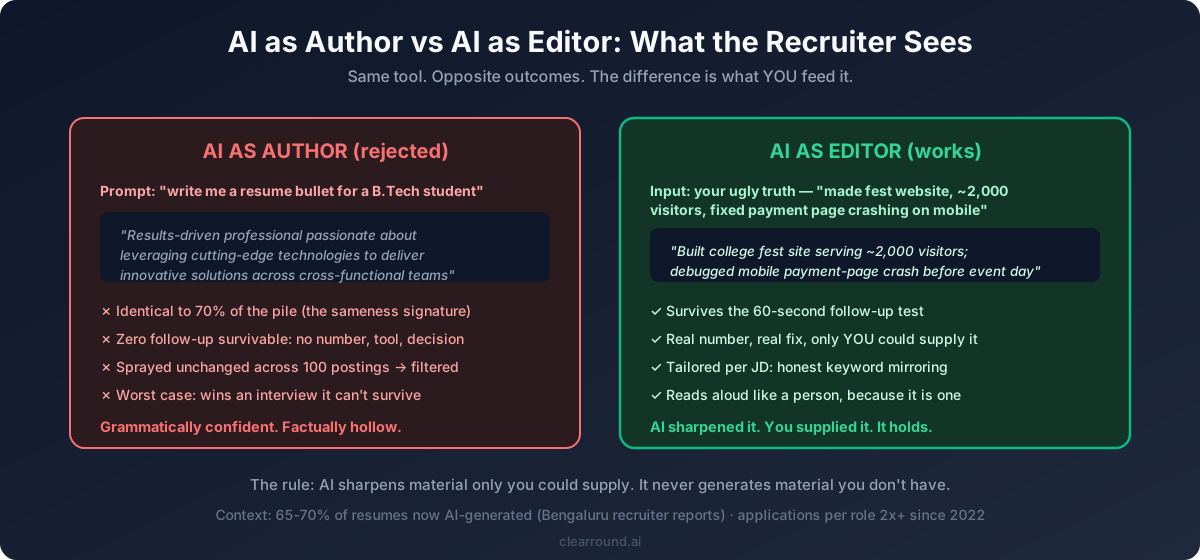
The line between failing and working AI usage is simple to state: AI should sharpen material only you could supply, never generate material you don't have. In practice, five rules:
1. Feed it your raw truth first. Before any AI touches your resume, write the ugly version yourself: what you built, the numbers you actually moved, the tools you actually used, what broke. AI turning "made the college fest website, around 2,000 visitors, fixed the payment page crashing on mobile" into a sharp bullet is editing. AI answering "write me a project bullet for a B.Tech student" is fiction.
2. One follow-up test per line. For every bullet, ask: can I speak for 60 seconds about this if probed? Delete or rewrite anything that fails. This single filter removes most AI-slop tells, because slop is precisely the content with nothing underneath it.
3. Tailor per JD, honestly. Mirror the job description's actual skill terms where they're true of you, and only where they're true. This is what beats the ATS keyword filter legitimately, and it's the opposite of mass-applying: ten tailored applications outperform a hundred identical ones, mathematically and reputationally. Check each version against its specific JD with the ATS resume checker before sending.
4. Cover letters: one paragraph of proof beats five of prose. The letters that survive say something only you could say: why this company specifically (one researched detail), one relevant thing you've actually done, one honest sentence about what you want to learn. If a paragraph could be pasted into any other application unchanged, cut it.
5. Read it aloud. The fastest authenticity test that exists. AI-generated prose that you'd never say out loud ("I am eager to leverage synergies") announces itself the moment it hits your own ears. If you wouldn't say it in the interview, don't write it in the application, because in 2026, the interview is where every written claim gets audited.
This is, for the record, exactly how we built our own resume builder: it imports your real profile and turns your actual experience into sharp bullets, and it will not invent metrics you didn't provide, because a resume that outruns its owner fails at the interview it wins. AI-assisted, grounded in your truth. That combination is not just the ethical position; in a pile where 70% is unguided AI output, it's the competitive one.
The candidates winning in 2026 aren't the ones avoiding AI or the ones automating everything. They're the ones who understood that AI raised the floor for everyone, which means the differentiator moved to the one thing it can't generate: things that actually happened to you, told specifically, and defensible out loud.
Check your ATS resume score
Drop your resume. Get your score + missing keywords in 10 seconds.
Check ATS Score →Frequently Asked Questions
Priti
AI interview preparation insights from the ClearRound team.