
Every year, thousands of freshers apply to "Deloitte" without realising they are actually applying to one of two different employers, with different clients, different roles and a salary gap of several lakhs between them. Understanding that split is worth more than any aptitude shortcut, so this guide starts there.
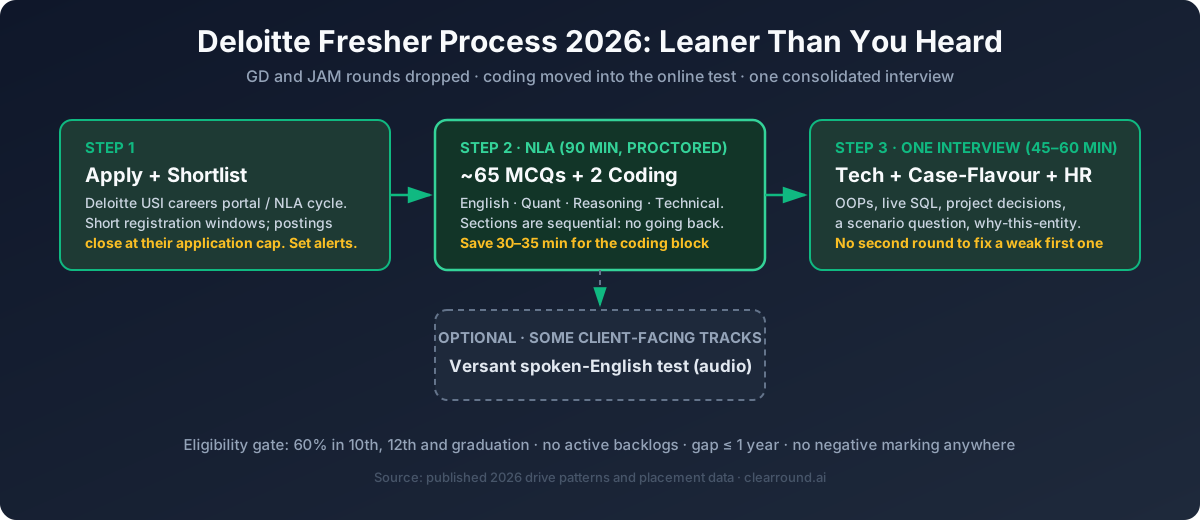
The other thing worth knowing upfront: the process got leaner in 2026. The group discussion and JAM rounds that older guides describe have been dropped, coding has moved into the online test, and the interview is now typically a single consolidated round. If your senior cleared Deloitte in 2023, their process is not your process.
First, Which Deloitte Are You Applying To?
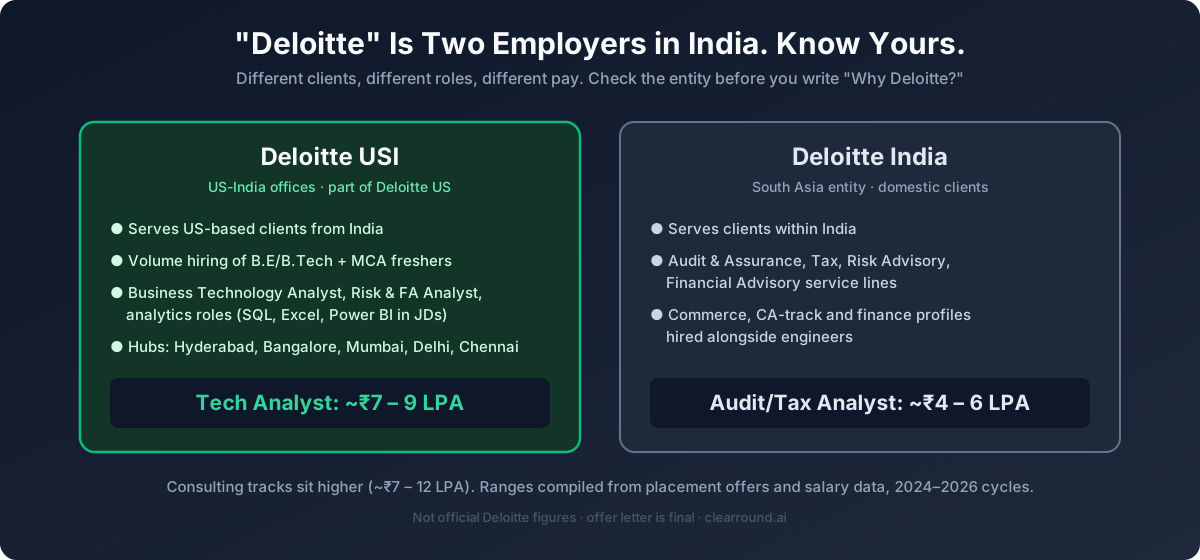
| Comparison | Deloitte USI | Deloitte India |
|---|---|---|
| Who it serves | US-based clients, delivered from India | Clients within India |
| Typical fresher roles | Business Technology Analyst, Risk and Financial Advisory Analyst, analytics roles | Audit and Assurance, Tax, Risk Advisory, Financial Advisory |
| Who it hires | Mostly B.E/B.Tech (plus MCA) | Commerce, CA-track and finance profiles alongside engineers |
| Delivery hubs | Hyderabad, Bangalore, Mumbai, Delhi, Chennai | Major metros |
| Reported fresher CTC | ~₹7 to 9 LPA (technology analyst) | ~₹4 to 6 LPA (audit/tax analyst) |
Consulting tracks sit higher still, roughly ₹7 to 12 LPA per compiled placement data, and MBA hiring is a separate world entirely. All figures here are ranges compiled from placement offers and salary data for the 2024 to 2026 cycles, not official Deloitte numbers.
Insider Tip: For engineering freshers, USI is the realistic target: it runs the volume hiring and the technology analyst roles. When you see a Deloitte posting, check the entity and the service line before applying, because "why do you want this role" answers that describe consulting glamour in an audit-delivery interview are an instant signal you did not read the JD.
Quick Facts
| What to know | Details |
|---|---|
| Screening test | NLA (National Level Assessment), 90 minutes, proctored |
| Test content | ~65 MCQs (English, quant, logical reasoning, technical) + 2 coding problems |
| Negative marking | None |
| Section navigation | Sequential: once you submit a section, you cannot go back |
| Interview | Typically one consolidated technical + HR round in 2026 |
| Extra round | Versant spoken-English test for some client-facing tracks |
| Eligibility | 60% in 10th, 12th and graduation; no active backlogs; gap ≤ 1 year |
| Degrees | B.E/B.Tech (any discipline, full-time) and MCA for tech roles; NLA cycles have also opened to BSc, BCom and BBA for some roles |
Stage 1: The NLA (Online Assessment)
The NLA is Deloitte's national screening test, run on third-party proctored platforms (drives have used AMCAT and HirePro). It packs a lot into 90 minutes:
The MCQ block (~65 questions):
- English/verbal: grammar, sentence completion, reading comprehension
- Quantitative aptitude: arithmetic, percentages, profit and loss, probability, permutations
- Logical reasoning: coding-decoding, data sufficiency, blood relations, direction sense. This section runs at roughly one question per minute, the tightest pace in the test
- Technical MCQs: programming fundamentals, DBMS, and CS basics
The coding block (2 problems): one easy-to-medium, one medium-to-hard, in mainstream languages (C++, Java, Python).
Two structural rules decide more outcomes than the syllabus does. First, sections are sequential: once you complete a section you cannot return to it, so leftover time in one section is gone forever. Second, there is no negative marking, so every blank answer is a donated mark.
Insider Tip: Budget backwards from the coding block. Candidates who treat the MCQs as the "real test" and reach the coding problems with 15 minutes left lose the round there, because coding is where shortlists for the technology analyst roles are actually separated. A workable split: 55 to 60 minutes for MCQs, 30 to 35 for coding, and submit partial coding solutions rather than nothing.
Stage 2: The Interview (Now Usually One Round)
The 2026 structure consolidates technical and HR evaluation into a single interview for most fresher tracks, running 45 to 60 minutes. Expect four threads:
Technical fundamentals: OOPs with examples, SQL (write queries, not just define joins), and your primary language. For analytics postings, the JDs explicitly list SQL, Excel and Power BI or Tableau, so revise the tools named in your specific JD.
Project deep-dive: what you built, why those choices, what broke. Deloitte interviewers push on decisions ("why this database?") more than syntax.
Case-flavoured problem solving: not a formal consulting case, but expect a scenario question: how would you approach a client's messy data, or estimate something with incomplete information. They are scoring structure of thought. Think out loud in steps rather than jumping to an answer.
Fit and communication: why Deloitte, why this service line (see the entity section above), and a properly structured introduction. Our Tell Me About Yourself guide covers the formulas; given Big 4 client exposure, communication carries visibly more interview weight here than at pure IT services companies. An AI-awareness question is increasingly standard too; we broke down how to answer it in How to Answer "How Do You Use AI in Your Work?".
The Versant note: some client-facing tracks add Pearson's Versant spoken-English test, a telephonic/audio assessment of reading, listening and repeating tasks. If it appears in your track, the standard AI-audio rules apply: silent room, clear steady speech, no rushed accent-performance.

Eligibility, Honestly Stated
The consistent criteria across 2026 drives: minimum 60% in 10th, 12th and graduation, no active backlogs (cleared backlogs are fine), and an education gap of not more than one year. Engineering drives take B.E/B.Tech across disciplines (full-time only) plus MCA. NLA cycles have periodically opened to BSc, BCom and BBA graduates for analyst roles, so non-engineers should watch the drive notification rather than assume exclusion.
Timing matters more at Deloitte than at TCS-style mass recruiters: NLA registration windows are short (the early-2026 cycle's registration closed within days in January), and high-volume postings close once applications hit their cap. Set up alerts on the Deloitte USI careers portal instead of waiting for aggregator posts.
Your 3-Week Prep Plan
Week 1: NLA MCQs. Daily timed aptitude and reasoning sets at the one-question-per-minute pace, plus English comprehension. Fix your resume against the JD tools list; the fresher resume format guide and the ATS resume checker cover that.
Week 2: Coding + SQL. Two timed problems daily (arrays, strings, hashmaps), plus SQL query writing by hand. Analytics aspirants: add Excel functions and one visualisation tool.
Week 3: The consolidated interview. Prepare your project story, your entity-and-service-line answer, one structured approach to case-flavour questions, and your AI-usage answer. Then rehearse out loud, because a single consolidated interview means no second chance in a later round to fix a weak impression. A company-specific mock interview loads Deloitte's patterns and scores your spoken answers across 5 dimensions, which is the closest you can get to the real 45 minutes before they happen.
Deloitte rejects more candidates on preparation-mismatch than on ability: wrong entity in their answers, old process in their expectations, and no time left for coding. Fix those three and you are ahead of most of the applicant pool.
Practice with our AI interviewer
Voice mock interview with scored feedback. Free session.
Start a mock interview →Frequently Asked Questions
Priti
AI interview preparation insights from the ClearRound team.