
Here is the thing about EY that changes your entire preparation strategy: there is no EY exam. No NQT, no NLA, no national assessment with lakhs of registrations and a rank list. EY GDS hires the way lateral employers do: role-specific requisitions posted year-round, recurring virtual and walk-in interview drives, and a referral culture that actually moves applications.
That means the skills that clear TCS or Deloitte (grinding aptitude PDFs, exam-day time management) matter less here, and the things freshers usually neglect (a JD-matched resume, a referral, and interview-ready speaking skills) matter much more. This guide covers how EY hiring actually works in 2026 and how to prepare for it.
First: EY GDS vs EY India
Same pattern as we covered in the Big 4 series: two entities, different work.
| Comparison | EY GDS | EY India |
|---|---|---|
| What it is | Global Delivery Services: delivery centres supporting EY member firms worldwide | The domestic member firm serving clients in India |
| Fresher work | Technology, analytics, tax, assurance and consulting delivery for global clients | Audit, tax and advisory for Indian clients |
| Hiring style | High-volume, year-round requisitions and drives | Campus-heavy, CA-track and finance profiles alongside engineers |
| 2026 drive locations seen | Bangalore, Pune, Hyderabad (in-person and virtual drives) | Major metros |
For engineering and analytics freshers, GDS is where the volume is. EY employs close to 4 lakh people globally, and GDS is the delivery backbone of that network.
Quick Facts
| What to know | Details |
|---|---|
| Hiring model | Requisition-based, year-round; virtual and walk-in drives run regularly |
| Typical stages | Application/screening → online assessment (role-dependent) → technical/functional interview → HR |
| Campus additions | Pre-placement talk and GD appear in some campus drives |
| Assessment content | Quantitative, logical and verbal aptitude + technical MCQs for tech roles |
| Fresher CTC | ~₹3.5 to 5 LPA (tax/assurance analyst), ~₹5 to 8 LPA (tech/analytics tracks), per Glassdoor and placement data |
| Interview weight | Excel, SQL and analytics fundamentals dominate analyst interviews |
| What matters most | JD-matched resume, referrals, spoken communication |
One honesty note on salaries: EY GDS compensation varies more than exam-based mass recruiters because offers are per-requisition, not per-batch. Glassdoor places fresher tax analyst pay around ₹3 to 4 LPA and the broader GDS average materially higher, driven by tech and experienced roles. Treat every figure as a band and your offer letter as the truth.
How EY Hiring Actually Works (And Why It Changes Your Strategy)
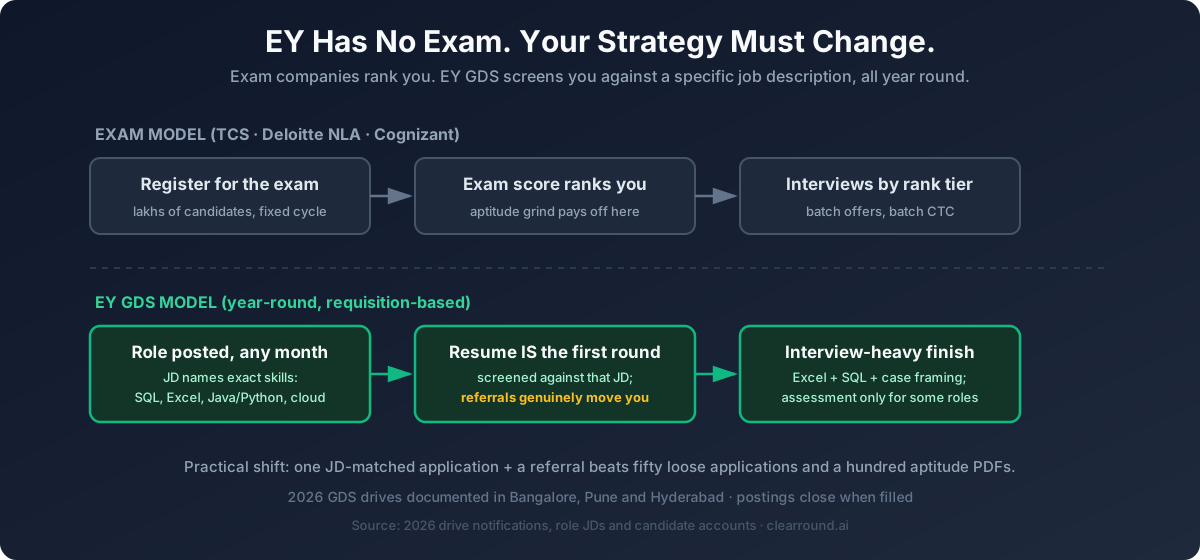
At exam companies, the funnel is: register → exam rank → interview. At EY GDS, the funnel is: requisition posted → resumes screened against the JD → assessment (sometimes) → interviews. Three practical consequences:
1. Your resume is the exam. Screening is against the specific JD's skills list (a 2026 tech posting typically names Java or Python, SQL and cloud fundamentals; analytics postings name SQL, Excel, Power BI or Tableau). Interview accounts consistently note that a strong academic record helps but is not decisive; relevant projects and clean formatting matter more. Mirror the JD's exact skill terms in your resume before applying; our fresher resume format guide covers the structure and the ATS resume checker will show you the gaps.
2. Referrals genuinely move applications. Multiple candidate accounts describe referral-routed interviews for fresher analyst roles. One respectful LinkedIn message to an EY employee in your target team, with a specific role link attached, outperforms fifty cold applications.
3. Timing is continuous, so speed wins. EY GDS ran documented in-person and virtual interview drives through February, May and June 2026 in Bangalore, Pune and Hyderabad. Postings close when filled. Set alerts on the EY careers portal, and when a matching requisition appears, apply that day.
Insider Tip: Because hiring is per-requisition, applying to one perfect-match role beats applying to ten loose matches. Recruiters screening a specific requisition reject "good candidate, wrong profile" without a second look, and repeated mismatched applications do you no favours in the same portal.
The Stages, In Detail
Stage 1: Application and Screening
Covered above: JD-matched resume, ideally with a referral. Requisitions verify academics and documents at this stage, so keep marksheets ready.
Stage 2: Online Assessment (Role-Dependent)
Not every EY role tests, but when an assessment appears it covers quantitative aptitude, logical reasoning and verbal ability, plus domain or technical MCQs for tech roles. Standard difficulty; if you have prepared for any Big 4 or IT services assessment, the content overlaps heavily. The differentiator at EY is what comes after.
Stage 3: Technical / Functional Interview
This is where EY analyst offers are won. From candidate accounts and role JDs, the consistent pattern for fresher analyst roles:
- Excel, properly. Not "I know Excel" but lookups, pivot tables, and reasoning through a data problem. Fresher HR-round accounts mention basic analytics and Excel questions even in referral-routed processes.
- SQL, consistently hard. Interview intelligence for EY analytics roles flags SQL as demanding across rounds: joins, aggregations, subqueries, written live.
- Case-flavoured questions as the differentiator. How would you structure this business problem, what data would you ask for. They score your framing, not a right answer. Practise saying your structure out loud in steps.
- For tech requisitions: your language (Java/Python), projects, and cloud fundamentals as named in the JD.
Insider Tip: EY interviewers frequently anchor on your projects, so pick your best one and prepare it three ways: the 30-second version, the 3-minute version, and the "defend your decisions" version. Candidates who can only describe what they built, not why, stall exactly where Big 4 interviews probe.
Stage 4: HR Interview
Communication carries real weight at a firm whose deliverables are client-facing. Expect the standard set (introduction, why EY, relocation and shift flexibility for global-client teams), delivered conversationally. Structure your introduction properly (Tell Me About Yourself guide), and have your AI-usage answer ready, since it's now a standard question across Big 4 interviews; we broke down the framework in How to Answer "How Do You Use AI in Your Work?".
Post-interview, EY's portal statuses genuinely confuse candidates (requisition changes, mixed statuses, background verification stages appearing alongside rejections for parallel roles). A status change on one requisition often just means you were moved to another, so wait for the HR call before reading anything as final.
Your 3-Week Prep Plan
Week 1: Resume + pipeline. Rewrite your resume against 2 or 3 target JDs, quantify your project outcomes, send referral requests, set portal alerts. This week does more for your EY odds than any aptitude practice.
Week 2: Excel + SQL + aptitude. Daily SQL query writing by hand, Excel lookups and pivots on a real dataset, and timed aptitude sets in case your role tests.
Week 3: Interviews, out loud. Your project in three versions, one practised case-framing structure, your introduction and AI answer. EY's process is interview-heavy by design, which makes spoken practice the highest-leverage hour you have: a company-specific mock interview loads EY's patterns and scores your answers across 5 dimensions before a real recruiter does.
The freshers who get into EY GDS are rarely the ones with the best exam scores, because there is no exam. They are the ones whose resume matched a live requisition, who got seen through a referral, and who could talk through a data problem clearly. All three are buildable in three weeks.
Practice with our AI interviewer
Voice mock interview with scored feedback. Free session.
Start a mock interview →Frequently Asked Questions
Priti
AI interview preparation insights from the ClearRound team.