
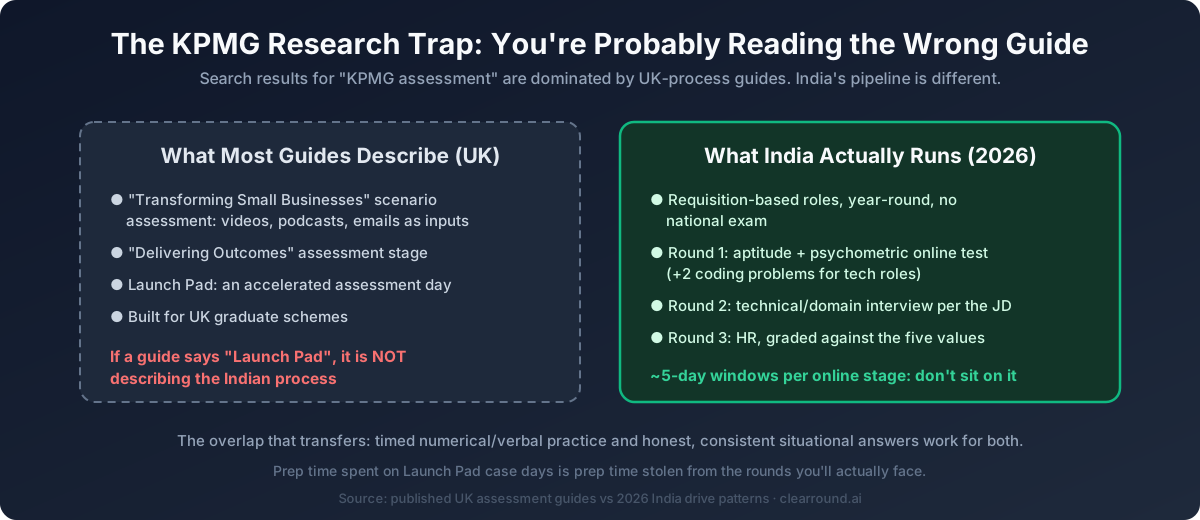
KPMG is the quiet one in the Big 4. No national exam with a famous name, no viral test format, and far less content written about its Indian hiring than Deloitte's NLA or PwC's games. That silence creates two problems for candidates: most "KPMG assessment" guides you'll find describe the UK process (Launch Pad, the "Transforming Small Businesses" scenario test), which is not what Indian applicants face, and almost nobody explains that KPMG has one of the widest any-graduate doors in the Big 4.
This guide fixes both: the actual India process, the KGS vs KPMG India split, and the roles B.Com and BA graduates can realistically win.
First: KGS vs KPMG India
The same two-entity pattern we've mapped across the Deloitte and EY guides completes here. Every Big 4 firm runs a domestic practice and an India-based global delivery arm, and KPMG's is KGS:
| Comparison | KPMG Global Services (KGS) | KPMG India |
|---|---|---|
| What it is | KPMG's India-based global delivery organisation | The Indian member firm |
| Who it serves | KPMG member firms and their clients worldwide | Clients within India |
| Typical fresher work | Analytics, audit delivery support, tax delivery, technology, compliance operations | Audit and Assurance, Tax, Advisory for Indian clients |
| Hubs seen in 2026 postings | Bengaluru, Pune, Gurugram | Major metros |
Globally, KPMG describes itself as a network of over 200,000 professionals across 150+ countries, and the India delivery engine is a large part of how that network runs. For volume fresher hiring, KGS and KPMG India's operations teams are where most requisitions appear.
Quick Facts
| What to know | Details |
|---|---|
| Hiring model | Requisition-based, year-round; no national exam |
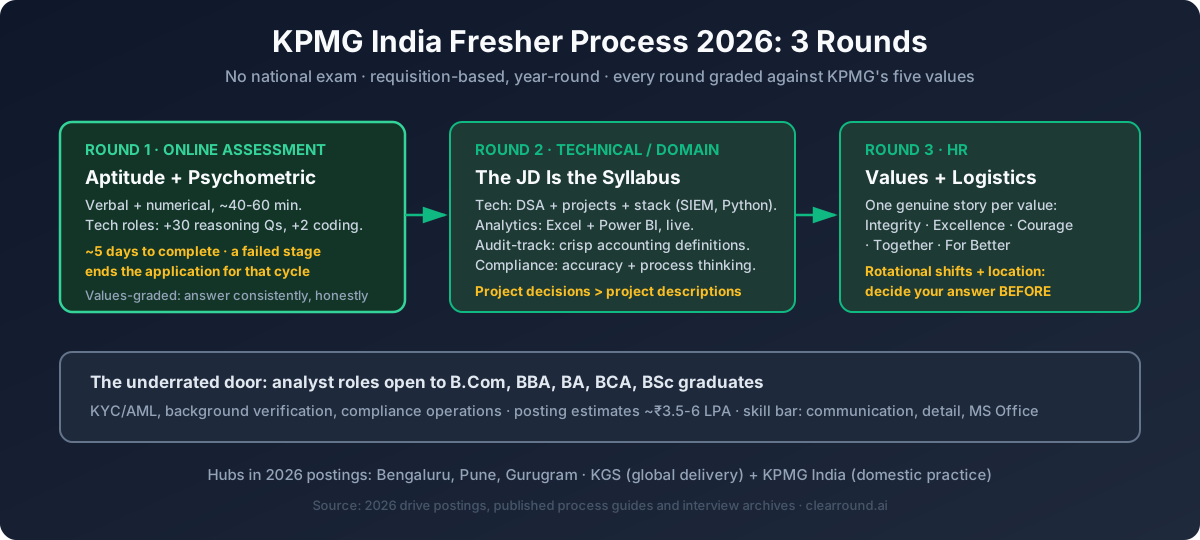
| Typical rounds | 3: online assessment → technical/domain interview → HR interview |
| Assessment content | Aptitude (verbal + numerical, ~40 to 60 min) + psychometric; coding (2 problems) for tech roles |
| Completion window | Typically around 5 days per online stage; a failed stage ends that cycle's application |
| Values grading | Candidates are assessed against KPMG's values: Integrity, Excellence, Courage, Together, For Better |
| Degrees | B.E/B.Tech for tech; B.Com, BBA, BA, BCA, BSc explicitly eligible for many analyst roles |
| Fresher CTC | ~₹3.5 to 6 LPA for compliance/operations analyst roles (posting estimates); tech roles higher, per requisition |
| Backlogs | No backlogs at the time of interview (per drive criteria) |
| Live example | Analyst (Employee Vetting), Pune, any graduate, applications open till 30 Aug 2026 |
Insider Tip: Before you prepare anything, check which process you're reading about. Search results for "KPMG assessment" are dominated by UK guides describing Launch Pad assessment days and the "Transforming Small Businesses" scenario test. Those are real, and they are not India's process. If a guide mentions Launch Pad, it's describing another geography. India's pipeline is the three-round structure below.
The 3 Rounds, In Detail
Round 1: Online Assessment
The composition depends on the role family, and this is where KPMG differs by requisition more than any Big 4 peer:
For most analyst roles: aptitude (verbal ability and numerical ability, roughly 40 to 60 minutes) plus a psychometric section. The questions are not hard; the time limit is the test. Reported candidate experience across Big 4 assessments is blunt about this stage: a weak score ends your application before any human reads your profile.
For tech roles (SDE, data, cyber): add roughly 30 aptitude questions, 30 logical/verbal questions, and 2 medium-difficulty coding problems. Interview archives show KPMG SDE hiring running genuine DSA rounds, so tech applicants should prepare like it's a product-company screen, not an audit firm formality.
The psychometric/situational sections are values-graded. KPMG explicitly assesses against its five values (Integrity, Excellence, Courage, Together, For Better). Answer consistently and honestly; contradictory "ideal employee" answers across similar scenarios are exactly what these instruments flag.
Two logistics rules that reject people on process, not ability: you typically get around five days to complete each online stage, and a failed stage ends that application for the cycle. Complete the assessment early in your window on a quiet setup; don't burn a Big 4 application on a phone attempt in a noisy hostel.
Round 2: Technical / Domain Interview
Role-dependent, and the JD tells you exactly what to prepare:
- Analytics roles: Power BI and Excel are named in screening criteria; expect them live, plus data-handling reasoning
- Compliance/KYC/AML and verification roles: attention to detail, process thinking, basic domain awareness, and communication; accuracy is explicitly critical in these roles
- Tech roles: DSA, projects, and role-specific stacks (2026 cyber postings name SIEM tools like Sentinel and Splunk, plus Python scripting)
- Audit/tax-track roles: accounting fundamentals asked as crisp definitions: depreciation, revenue recognition, accrual basics. Campus candidates get these quick-fire, so know them cold
Across all tracks, project decisions matter more than project descriptions: why this choice, what broke, what you'd change. And the now-universal Big 4 question about how you use AI tools deserves a prepared answer; our framework guide covers it.
Round 3: HR Interview
Standard structure: introduction (Tell Me About Yourself formulas), why KPMG, situational questions, and logistics. Two logistics answers to think through before, not during: rotational shifts (explicitly required in several 2026 postings, especially cyber and global-delivery roles) and location flexibility across Bengaluru, Pune and Gurugram hubs. The values grading continues here; KPMG interviewers map situational answers to the five values, so having one genuine story per value (a time you pushed back honestly, a team result, a hard call) is the highest-leverage HR prep for this specific firm.
The Any-Graduate Door (KPMG's Underrated Edge)
Here's what almost no Big 4 content tells commerce and arts graduates: KPMG regularly posts fresher analyst roles explicitly open to B.Com, BBA, BA, BCA and BSc graduates, in employee vetting and background checks, KYC/AML, compliance operations and similar functions. A live example while writing this: Analyst, Employee Vetting and Background Checks, Pune, any graduate, applications open until 30 August 2026.
Posting-based salary estimates for these roles run roughly ₹3.5 to 6 LPA, and the skill bar is communication, attention to detail, analytical thinking and basic MS Office, all buildable in weeks. For a non-engineer who wants a Big 4 brand on their resume, this is one of the most realistic entry points that exists, and it's nearly invisible because placement content only covers engineering drives.
Tech-role pay sits higher and varies by requisition (analytics and AMTS-level positions are noted as paying more due to technical requirements); as with every guide in this series, verify the band for your specific posting and treat the offer letter as final.
Your 3-Week Prep Plan
Week 1: Find the right requisitions + assessment basics. Set alerts on KPMG's India careers portal, shortlist 2 or 3 JD-matched roles (the fresher resume format guide and ATS resume checker handle the screening side), and start daily timed verbal + numerical sets.
Week 2: Role depth. Tech: DSA at two problems a day plus your stack. Analytics: Excel and Power BI hands-on. Compliance/operations: attention-to-detail drills and domain basics (what KYC actually checks, why AML exists). All tracks: one story per KPMG value, written down.
Week 3: Interviews, out loud. Your introduction, your five value stories, your AI answer, your shift-and-location answer, practised as speech, not notes. A company-specific mock interview loads Big 4 patterns and scores your spoken answers across 5 dimensions, which matters double at a firm that grades every round against behavioural values rather than just technical checklists.
KPMG rewards exactly the candidate its quiet reputation attracts least: someone who found the right requisition, cleared a time-boxed assessment carefully, and walked into values-graded interviews with stories instead of adjectives. The applicant pool preparing properly for KPMG India is a fraction of the TCS crowd. That's your edge.
Practice with our AI interviewer
Voice mock interview with scored feedback. Free session.
Start a mock interview →Frequently Asked Questions
Priti
AI interview preparation insights from the ClearRound team.