
You knew the answer. You knew it in your head, in whatever language your head thinks in. Then the interviewer asked it in English, in a room with a clock, and the word you needed wasn't there. You said "so basically," then "actually," then nothing, and by the time the sentence came back, you were apologising instead of answering.
If this is you, here's the first thing to know: it is not an English problem in the way you think, and it is definitely not an intelligence problem. It's a load problem. This guide explains what's actually happening when your English freezes, gives you the phrases that legitimately buy thinking time, teaches the one skill that gets you out of a missing word, and says honestly where fluency does and doesn't matter in Indian hiring. No hacks, no "just be confident."
What's Actually Happening When You Freeze
Psycholinguistic research on bilingual speech is consistent: producing a second language in real time costs more cognitive resources than speaking your first. In an interview, your brain is running three jobs at once. The translator converts a thought from your thinking language into English. The perfectionist hunts for the right word, the right tense, the sentence that sounds as smart as you are. The fear manager monitors the interviewer's face for judgement about your accent or your grammar. All three draw from the same limited pool, and the answer itself gets whatever is left.
Then the loop closes. Anxiety increases the load. Load reduces fluency. Reduced fluency increases anxiety. Under enough pressure the stress response floods the system and the part of your brain that handles language and complex thought goes offline for a few seconds. That's the blank: not stupidity, not poor English, a protective shutdown.
This is why "take a deep breath and be confident" doesn't fix it. The breath helps, but it doesn't address the language layer creating the load. The fixes below do, in three places: before the interview, in the moment, and in how you practise.
Buying Time Without Sounding Like You're Stalling
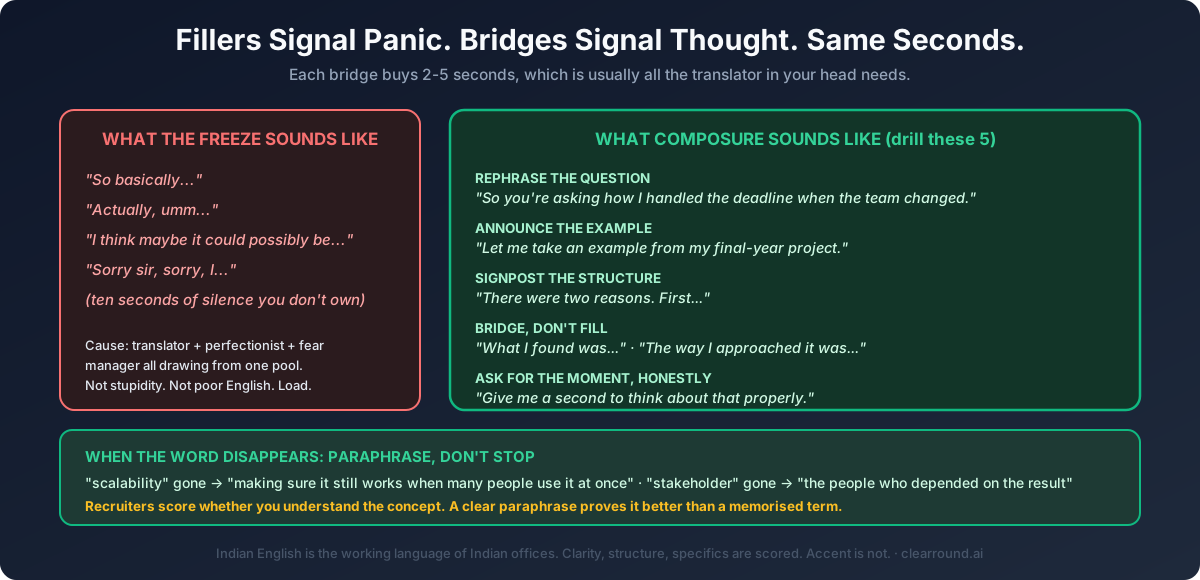
Native speakers stall constantly; they've just learned to do it in phrases that sound like thinking. Borrow the same moves. Each buys two to five seconds, which is often all the translator needs.
Repeat or rephrase the question. "So you're asking how I handled the deadline when the team changed." You've confirmed understanding, gained four seconds, and your first sentence is already structured.
Announce the example. "Let me take an example from my final-year project." The interviewer now expects a story, which is better than a definition, and you've bought time while sounding deliberate.
Name the structure out loud. "There were two reasons. First..." Signposting gives you a scaffold to climb even when the words come slowly, and it makes the answer easier to follow.
Use a bridge, not a filler. Fillers ("so basically actually") signal panic. Bridges ("what I found was," "the way I approached it was," "the key thing there was") signal thought. Same seconds, opposite impression. Pick five and drill them until they arrive without translation.
Ask for a moment, honestly. "Give me a second to think about that properly." Interviewers rate this far higher than a rushed wrong answer. Silence you own reads as composure; silence that owns you reads as a freeze.
One thing to unlearn: stacked hedges. "I think maybe it could possibly be" is a habit many of us carry from politeness norms, and it dilutes a correct answer into a doubtful one. Say the thing, then qualify once if needed.
When the Word Disappears: Paraphrase, Don't Stop
The most useful single skill for a non-native speaker in an interview is paraphrasing on the fly. The word "scalability" is gone? Say "making sure it still works when many people use it at once." Can't find "stakeholder"? "The people who depended on the result." Bridge in with "what I mean is" and describe the concept in plainer words.
Two things make this work. First, interviewers are scoring whether you understand the concept, and a clear paraphrase proves that more convincingly than a memorised term. Second, native speakers do this all the time; it's how fluent people handle the words that escape everyone. Practising it deliberately (take ten technical terms from your field and explain each in plain words, aloud) turns the moment of panic into a move you already know.
And if a full blank still hits: name it, briefly, and restart. "Sorry, I lost the thread. Let me start that again." Then begin with the structure: "Two reasons. First..." Admitting a blank costs a second. Filling it with "um" for ten seconds costs the answer.
The Honest Part: Where Fluency Does and Doesn't Matter
Here is what recruiters at Indian companies actually score in technical and HR rounds: relevance to the question, structure, specifics, and clarity of delivery. Not accent. Not vocabulary size. Indian English is the working language of Indian offices, and the interviewer sitting across from you speaks it too. A structured answer with a real decision and a real number, delivered in your own English with two pauses, beats a fluent answer with nothing in it, every single time. The AI-led rounds now common at the front of pipelines make this even more literal: they score the content of what you say, and a paraphrased concept survives a transcript perfectly well.
The honest caveat: fluency does gate some roles. Client-facing BPO tracks, Versant-style communication tests, and some consulting positions assess spoken English directly, and there the fix is sustained practice rather than interview-day technique. For most technical, analyst and operations roles, the gate is clarity, and clarity is trainable in weeks.
Practise the Language Layer, Not Just the Answers
Because the freeze is a load problem, the practice has to reduce load, and reading model answers does the opposite (it adds a memorised script to translate). What works:
1. Build a small glossary. Ten to fifteen terms from your field you'll actually need, eight to ten action verbs (built, reduced, fixed, chose, tested), and five to seven bridge phrases. Drill them aloud until they arrive without translation. This shrinks the translator's job.
2. Speak your real answers, timed, to something that asks back. Your project story, your introduction, your failure story, said aloud with a clock and a follow-up coming. Reading them in your head trains nothing the interview tests. A voice mock interview built for Indian English accents and vocabulary does this without the judgement that makes a friend or a mirror useless; the point is to make speaking under pressure familiar until the fear manager has nothing to manage.
3. Practise the recovery, not just the answer. Deliberately drop a word mid-answer and paraphrase around it. Deliberately blank, name it, restart with structure. When the recovery is rehearsed, the blank stops being a catastrophe and becomes a two-second event.
4. Repeat until it stops changing. When your recordings stop showing new stumbles in the same places, the load has dropped. For most people that's a fortnight of daily ten-minute sessions, not a year of grammar.
The word will still disappear sometimes. It disappears for everyone, in every language, under pressure. The difference between the candidate who loses the interview and the candidate who doesn't is not that one of them never freezes. It's that one of them has a bridge phrase ready, a plainer word for the missing one, and enough practice behind them that a two-second pause feels like composure, because that's exactly what it is.
Practice with our AI interviewer
Voice mock interview with scored feedback. Free session.
Start a mock interview →Frequently Asked Questions
Priti
AI interview preparation insights from the ClearRound team.