
Search "how many mock interviews should I do" and every answer gives you a number. Three to five. Four to six for freshers. Eight if it is a technical round.
None of those numbers come from measuring anything. Here is what happens when you do measure.
The short answer
Most people need fewer sessions than they think and more repetitions of one fix than they expect. Three to five practice interviews is a reasonable starting range. But the number is the least useful thing about your preparation, because a practice interview is a measuring instrument, and short instruments are imprecise.
That is not an opinion about interviews. It is how measurement works.
Why the number is the wrong question
A mock interview tries to measure something: how well you answer under pressure. Every measurement carries error. The shorter the measurement, the more error it carries.
This is the oldest result in psychometrics. The Spearman-Brown formula, which has been around for over a century, says the reliability of a test rises with its length. A three-question practice interview is a three-item test. It will give you a number, and that number will wobble.
So when you do one mock and score reasonably, then do another and score worse, the honest reading is usually not that you got worse. It is that you asked a short instrument to do a long instrument's job.
The research on real interviews says something similar about the interviewers themselves. The most recent large review of selection methods, Sackett and colleagues in 2022, puts the operational validity of a structured interview at about 0.42, and an unstructured one at about 0.19. For comparison, a cognitive ability test sits around 0.31.
Two things are worth pulling out of that.
First, structured beats unstructured by more than double. A structured interview asks every candidate the same questions and scores them against the same criteria. An unstructured one is a conversation. If you are practising, practise against structure, because that is what a well-run company will do to you.
Second, even the good version is far from certain. A validity of 0.42 is strong for this field and still means the interview is not reading you cleanly. The same review puts the 80% credibility interval for structured interviews between about 0.18 and 0.66. The same method, done in different places, produces very different accuracy.
Insider tip: When an interviewer asks loose, conversational questions and takes no notes, you are in an unstructured interview, and the outcome will lean more on impressions than on your answers. That is the round where a clear, structured answer stands out most, because almost nobody gives one.
What this looks like when you measure it
Research tells you short tests are noisy. Our own data tells you how noisy.
Across 10,000+ scored answers in ClearRound mock interviews, the same candidate's average moved by roughly 9.7 points when they answered a different set of questions. Nothing about the person changed between the two sessions. The questions did.
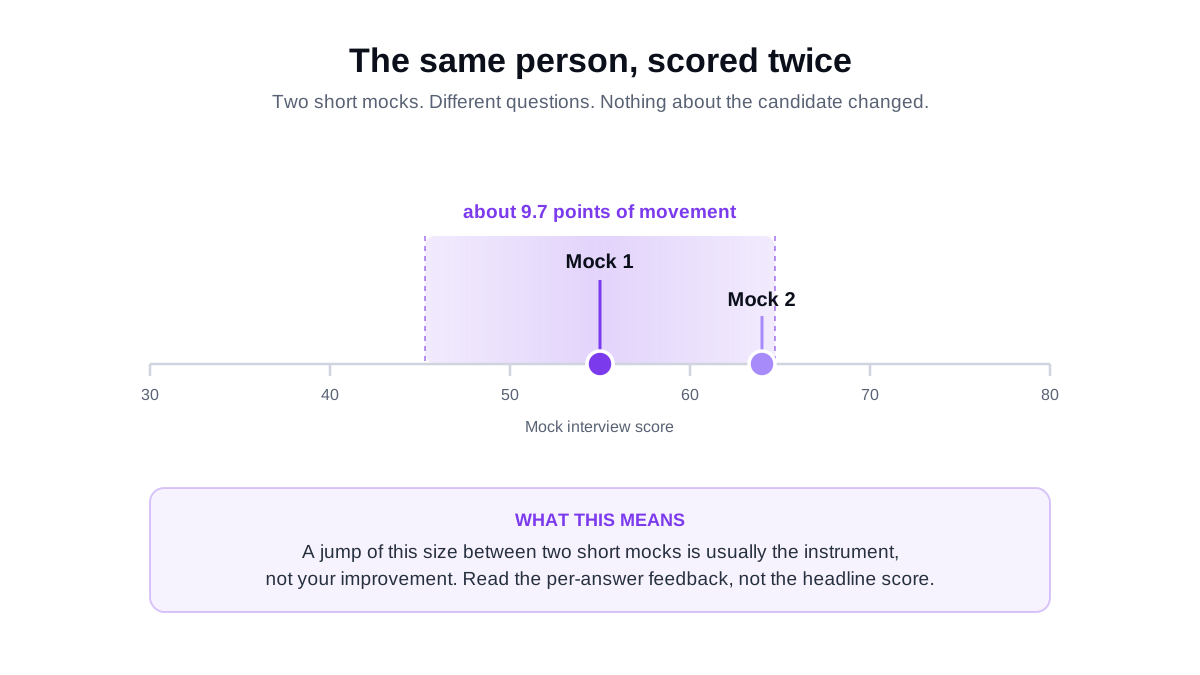
So if your second practice interview comes out eight points above your first, the honest reading is that you have learned almost nothing about whether you improved. You would need a bigger gap, or a longer session, or several sessions pointing the same way, before the number means anything.
This is our own measurement, not published research, and it is one platform's scoring rather than an industry finding. But it is the right order of magnitude to keep in your head when you look at a practice score.
Insider tip: If you want a score you can actually compare, hold something constant. Same question type, same length, same time of day. Change one thing at a time, which is what you would do with any other measurement.
What to count instead
If the number of mocks is not the variable, what is?
One named weakness, fixed, and retested. That is the loop. Everything else is activity.
A session that ends with "that went okay" has produced nothing you can act on. A session that ends with "I never said what the outcome was" has produced one thing, and your next session has a job.
Here is the difference in practice.
| Doing mocks | Running the loop |
|---|---|
| Answer ten questions, feel better | Answer three, find the weakest answer |
| Read the overall score | Read what that one answer was missing |
| Book another session | Rewrite that answer, out loud, twice |
| Hope the score goes up | Practise a question that tests the same gap |
| Repeat until the interview | Stop when the gap closes, move to the next one |
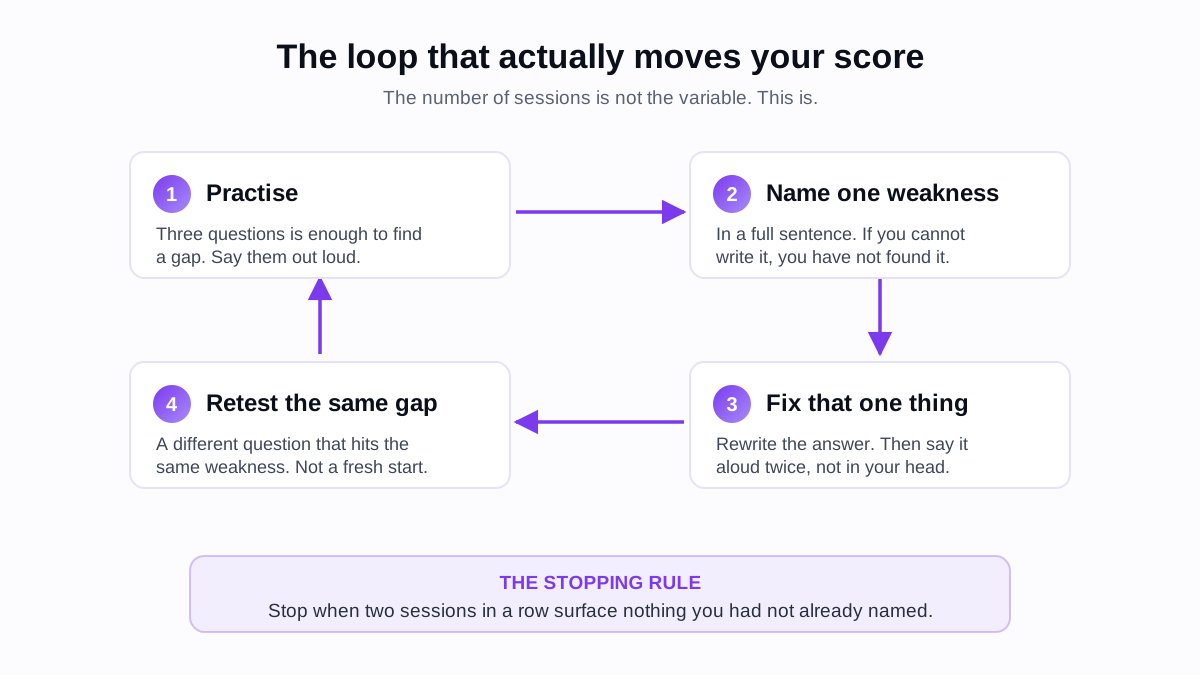
The left column is what most people do, and it is why people finish eight practice interviews no better than they started. The right column is slower per session and finishes sooner.
Insider tip: Write your one weakness down as a sentence you could say to someone else. "I describe what the project was and never what changed because of it." If you cannot write it in a sentence, you have not found it yet, and another mock will not find it for you.
So, practically, how many?
With the caveat that these are starting points and your gaps decide the real answer:
| Your situation | Sessions | What each one is for |
|---|---|---|
| Interview in two days | 1 to 2 | Find the single biggest gap, fix only that |
| Fresher, first real interview | 3 to 5 | One for the shock, the rest for the loop |
| Experienced, switching after some years | 2 to 4 | Mostly structure and recency, you already have the content |
| Campus season, several companies | 4 to 6 over weeks | Spread them, one fix each, not a block in one night |
The stopping rule matters more than the starting number. Stop when two sessions in a row surface no new weakness you had not already named. At that point more practice is rehearsal, which is fine, but it is not improvement, and your time is better spent on the company you are actually interviewing with.
Three ways people waste the practice
1. Treating the score as a verdict. A practice score is a rough instrument. If it says you are not ready, read what it says about the specific answers rather than the headline. If it says you are ready, do not stop reading either.
2. Doing them silently. Reading a model answer is not practice. The gap most people have is not knowing what to say, it is producing it out loud under pressure with someone watching. If you practise in your head, you have rehearsed the easy half.
3. Answering only the questions you like. The questions you avoid in practice are the questions that will cost you. If you have skipped "tell me about a time you failed" four times, that is your weakness and you have been protecting it.
Insider tip: Record one practice answer and listen to it the next day rather than straight away. You will hear the filler, the vagueness and the missing outcome far more clearly once you have forgotten what you meant to say.
Why this is worth doing right now
Indian IT hiring has turned, but not evenly. The five largest IT services firms added a net 16,055 people in the first half of FY27, against 3,097 in the same period a year earlier. Freshers made up an estimated 60 to 65% of that net hiring, roughly 12,000 to 13,000 graduates. Infosys is targeting about 20,000 graduates this financial year and TCS around 25,000.
But the same half saw Wipro's headcount fall by 6,716. The hiring is real and it is concentrated. Which means more people interviewing for a narrower set of seats, and the interview itself carrying more weight than it did two years ago.
That is an argument for practising properly, not for practising more.
Related reading
- AI Mock Interviews: How to Practise When Nobody Gives You Feedback
- Resume-Based Mock Interview: Practise the Questions You'll Actually Get
- How to Talk About Your Projects in an Interview With No Work Experience
- Why Mock Interviews Matter in India
If you want to run the loop rather than just book sessions, ClearRound's mock interview practice scores each answer separately and names the weakest one, so every session ends with something specific to fix. The first one is free, three questions, no card.
Practice with our AI interviewer
Voice mock interview with scored feedback. Free session.
Start a mock interview →Frequently Asked Questions
Priti
AI interview preparation insights from the ClearRound team.