
"Explain your project" is the most predictable question in a fresher interview, and freshers fail it in one of two identical ways. Either they say "we" for two minutes and the interviewer quietly concludes a smarter teammate did the work, or they read out a stack: "For the frontend I used React, for the backend Node and Express, for the database MongoDB, it has a login page, a cart page and a checkout page, thank you." The interviewer nods, writes nothing, and moves on. The candidate has just read their resume aloud to someone holding the resume.
Here's the reframe that fixes both: with no work experience, your project is your work experience, and the interviewer isn't asking what you built. They're asking how your brain works when something is hard. This guide shows how to explain a college project in an interview so it answers that question: the two traps, the structure, where to find real numbers in a student project, and before-and-after sample answers.
The Two Traps That Sink Project Answers
The "we" trap. Most final-year projects are group work, so the honest instinct is "we built the database, we designed the UI." The problem is that the company isn't hiring your group. When an interviewer hears only "we," the assumption is the least generous one available. The fix is brutal isolation of your part: "Two teammates built the UI; I owned the backend and the payment integration." Small and specific beats large and shared, every time.
The tool-list trap. Naming technologies feels like demonstrating skill, but the interviewer already knows your stack; it's printed on the page in front of them. What they cannot read is whether you made a single decision. In a year when AI can write React components and MongoDB schemas, the list proves nothing; the reasoning behind one choice proves everything. If your answer contains no "because," it contains no evidence.
Both traps have the same root cause, which the resume-based mock interview guide covers in depth: candidates have a mental picture of the project but have never said it out loud to someone who can ask a follow-up.
The Structure: STAR With a Learning Line
The STAR method works for freshers with one adjustment. Situation, Task, Action, Result, then Learning, because for someone without a track record, self-awareness is the evidence.
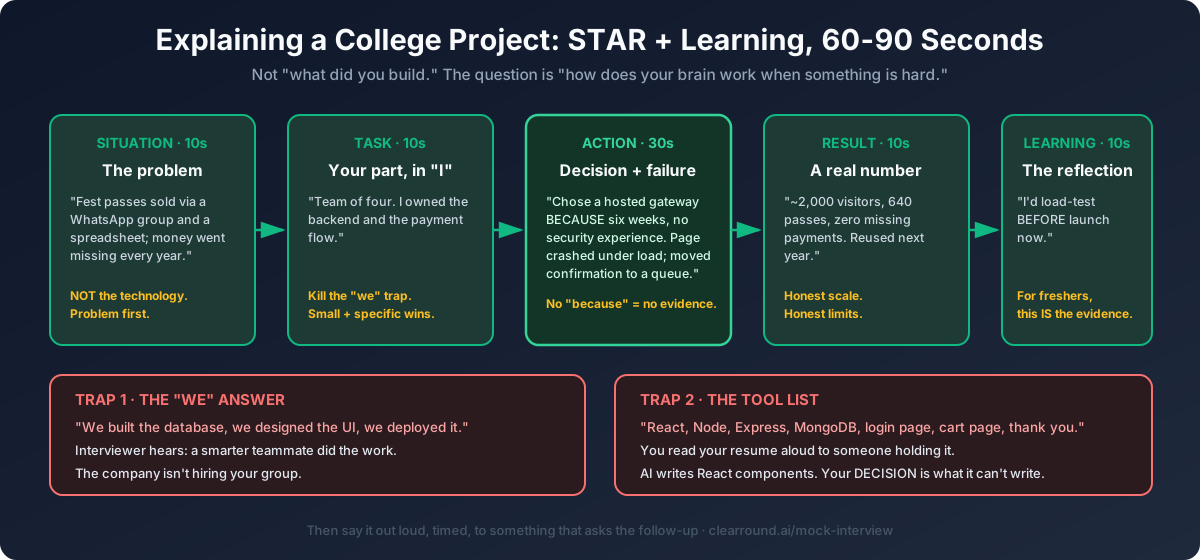
Situation (10 seconds). The problem, not the technology. "Our college fest sold passes through a WhatsApp group and a spreadsheet, and every year money went missing."
Task (10 seconds). Your specific responsibility, in "I." "In a team of four, I owned the backend and the payment flow."
Action (30 seconds). One decision and its reason, plus what went wrong. "I chose a hosted payment gateway over building our own checkout because we had six weeks and no security experience. Two nights before the fest, the payment page crashed on mobile under load; I found the webhook was timing out and moved confirmation to a queue."
Result (10 seconds). A number. "About 2,000 visitors, 640 passes sold, zero missing payments, and the committee reused it the next year."
Learning (10 seconds). "I'd load-test before launch now, not after. I assumed working on my laptop meant working for 500 people at once."
Sixty to ninety seconds. The interviewer now knows you made a decision, survived a failure, measured an outcome, and reflected. That's a hire signal, and not one word of it was a technology list.
Where the Numbers Hide in a College Project
"I don't have metrics, it was a college project" is almost never true. Every project has at least one honest number; the table is where to look:
| If your project... | Your number is... |
|---|---|
| Had any users (fest, club, class, family) | Visitors, sign-ups, passes, orders, downloads |
| Processed data | Rows, records, files, images handled |
| Replaced a manual process | Hours saved per week, steps removed |
| Had a deadline | Weeks from start to working demo |
| Was evaluated | Marks, grade, rank, jury feedback |
| Had bugs (all of them did) | Bugs found and fixed, crash rate before and after |
| Was a team effort | Team size, and your share of modules or commits |
| Ran on infrastructure | Requests handled, load tested, response time |
| Had a cost | Rupees spent, or saved by a free-tier decision |
Two rules for the numbers you find: honest scale ("about 2,000 visitors," not "thousands of users") and honest limits ("it wouldn't scale past a few hundred concurrent users, and here's why"). Interviewers trust the candidate who volunteers the ceiling.
Before and After: A Sample Answer
Before (the tool list): "Sir, my project is an attendance management system. I used Python and Flask for the backend and MySQL for the database and HTML, CSS for the frontend. It has student login, teacher login, and attendance marking. We deployed it on a free server."
After (the story): "Our department marked attendance on paper and re-entered it into Excel, and roughly one class a week got lost. In a team of three, I owned the database design and the teacher-side flow. My main decision was to make attendance marking work offline-first and sync later, because our classroom Wi-Fi was unreliable; I stored marks locally in the browser and pushed them when the connection returned. The first version double-counted students when two teachers synced at once, which I fixed with a per-class lock. It ran for one semester across 12 sections, about 600 students, and the department stopped keeping the paper register. If I did it again, I'd design the sync conflict handling first instead of discovering it in week five."
Same project. The second version contains a problem, an "I," a decision with a reason, a failure, three numbers and a learning. It's also about fifteen seconds longer, which is the correct price.
Build the Bank, Then Say It Out Loud
Prepare two or three projects this way, plus one internship or committee story for the behavioural questions (teamwork, conflict, deadline), and you have a story bank that covers most of a fresher interview. Then the step everyone skips: say them aloud, timed, to something that will ask the follow-up. Interviewers dig two or three levels into whichever project you seem proudest of ("why not a simpler solution?", "what would break at 10x?"), and the answers to those aren't in the story, they're in the practice. A mock interview that reads your own profile asks about your actual projects and builds case questions from them, which is exactly the depth-three drilling a real technical round does. The practice protocol covers how to run those sessions.
No work experience is not a disadvantage in this question. It's the reason the question exists. The interviewer wants to see what you did the night the payment page crashed, and that story is already yours; it just needs a structure, a number, and to be said out loud before the day it counts.
Practice with our AI interviewer
Voice mock interview with scored feedback. Free session.
Start a mock interview →Frequently Asked Questions
Priti
AI interview preparation insights from the ClearRound team.