
Here is a number that explains more about interview failure than any tip ever will: only about 5.5% of rejected candidates receive feedback they can actually use.
Think about what that means. The interview is a high-stakes skill you're expected to improve at. You fail one, and you get a template email or silence. You don't learn what went wrong, so you can't fix it, so you repeat it. Every other skill you've ever built (coding, driving, an instrument) came with a feedback loop. Interviewing, the skill that decides your salary for the next decade, comes with almost none.
That's the feedback vacuum, and it's the honest reason mock interviews matter, far more than "practice makes perfect." This guide covers what the research actually says, why most practice doesn't work, how to run an AI mock interview properly, and what to look for (and avoid) in a tool.
The Vacuum, by the Numbers
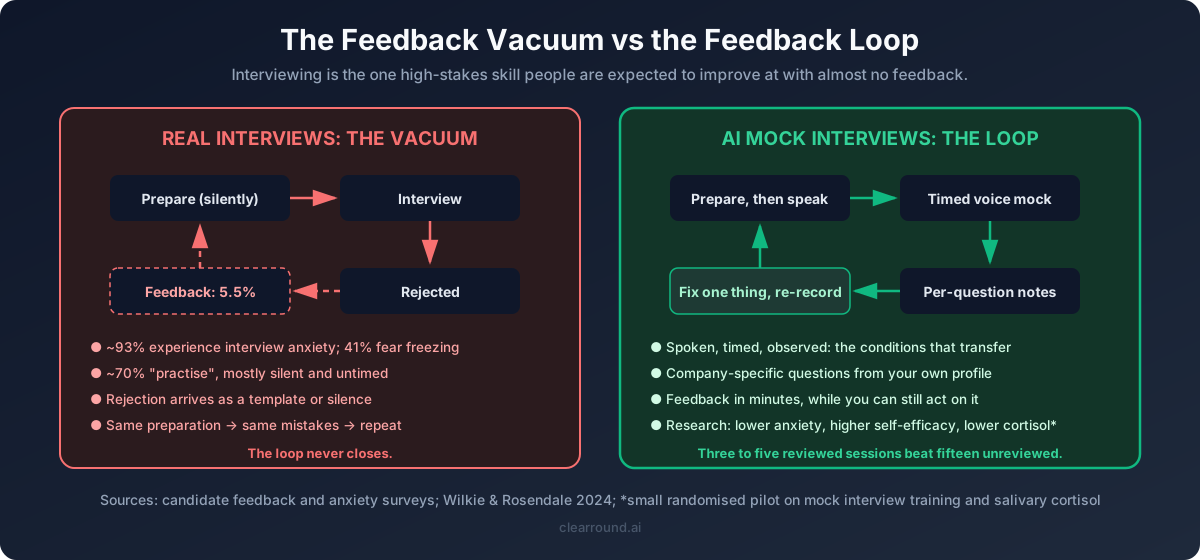
The anxiety is near-universal: surveys put interview anxiety at around 93% of candidates, and the single most common fear, cited by about 41%, is freezing on a difficult question. Roughly 70% of candidates say they practise answers before interviews, which sounds reassuring until you notice how: silently, in their heads, reading model answers. The mode of practice that feels productive is the one that transfers least, because interviews are spoken, timed, and observed.
Then the vacuum closes the loop. Rejected, no feedback, same preparation, repeat. Candidates can go through eight or ten interviews in a placement season and never once learn which specific thing they're doing wrong.
What the Research Actually Shows
This isn't motivational-poster territory; the evidence on structured practice is specific.
A 2024 peer-reviewed study (Wilkie and Rosendale, Journal of University Teaching and Learning Practice) found that virtual mock interviews increased students' preparedness and reduced anxiety, with the strongest predictor of good outcomes being how much preparation preceded the simulation. Practice compounds on preparation; it doesn't replace it.
Earlier action research with around 170 participants showed structured mock interview practice improved interview self-efficacy, grounded in Bandura's framework: confidence in a stressful domain comes from rehearsed success in that domain, not from reading about it.
And the most striking result: a small randomised pilot found that mock interview training produced significantly lower salivary cortisol, a biological stress marker, compared with studying interview materials alone. It was a small pilot in a specific population, so treat it as a strong signal rather than a settled fact, but the direction is clear. Practice doesn't just feel better. The body measurably calms.
Why Most Practice Fails Anyway
Because it's missing one or more of four ingredients, and missing any one of them breaks the loop:
Out loud. Reading an answer and saying it are different skills. The stumbles, the padding, the "um, let me start again" only exist when spoken. Silent practice hides exactly what interviews expose.
Timed and under observation. The pressure is the point. An answer you can give perfectly to your ceiling collapses to a clock and a listener, which is why practising with a friend who nods along also under-trains you. Interviewers, and increasingly AI-led screening rounds, don't nod.
Specific to the interview you'll face. Generic questions produce generic answers. A TCS technical round, a Big 4 values-graded HR round, and a startup's case discussion probe differently. Practice that ignores the target company trains you for an interview nobody will give you.
Feedback you can act on. This is the ingredient real interviews never supply. A score is nice; "your answer to the project question named no decision you made and no outcome" is the thing that improves the next one.
How to Run an AI Mock Interview Properly
An AI mock interview supplies all four ingredients by design: it's voice-based, timed, company-specific, and it scores per question with feedback. But the tool only works if you use it like training, not like a quiz. The protocol:
1. Prepare first, then simulate. Per the research, practice compounds on preparation. Have your introduction, your project story and your core answers drafted (tell me about yourself formulas, your AI-usage answer) before the first session, or you're rehearsing improvisation.
2. Pick the actual company and round. The value of company-specific mocks is that they reproduce the shape of the real thing. If the tool can load your own profile, better still: ClearRound's mock reads your Master Profile and asks about your actual projects, including case questions built from them, which is exactly how technical rounds probe and exactly the answer most candidates have never said aloud.
3. Full session, no pausing, no restarts. Treat the clock as real. The restart spiral (stumble, restart, panic) is a real failure pattern in AI-led rounds; the mock is where you train yourself out of it.
4. Read the feedback like a coach's notes, not a grade. Scores tell you where; the per-question notes tell you what. Find the one dimension that's lowest across answers (for most freshers it's specificity: claims without numbers, tools or decisions) and fix that one thing before the next run.
5. Re-record the weakest answer immediately. The single highest-value minute in the whole process. You just learned what was wrong; saying it right while the lesson is fresh is how the correction sticks.
6. Three to five sessions in the final fortnight, not fifteen. Each reviewed session beats several unreviewed ones. Spread them so each fixes something.
What to Look For (and Avoid) in a Tool
Honest criteria, because we have a stake here and you should know it:
Look for: voice-based practice (typing trains the wrong skill), company- or role-specific question sets, per-question feedback that names specifics rather than just scoring, transcripts you can review, pricing in rupees you can afford for a fortnight of practice rather than a year-long subscription, and speech recognition that handles Indian English accents and vocabulary, because a tool that mis-transcribes you scores you wrongly. Only around a quarter of candidates say they trust AI to evaluate them fairly, and that concern is legitimate; it's also exactly why you should judge a tool by whether its feedback matches what a human mentor would say about the same answer.
Avoid: anything that promises to answer questions for you during a live interview. The drift is real (one analysis found AI-assisted behaviour during interviews rose from about 15% to 35% in six months of 2025) and so is the consequence: detection is improving and disqualification is the outcome. We've written about why these tools are a trap; the short version is that renting an answer trains nothing, and the interview is a test of the skill, not the answer.
The interviewer will never tell you why you didn't get the offer. The mock interview will, in detail, ten minutes after you finish, while you can still do something about it. That's the entire case: not perfection through repetition, but a feedback loop for the one skill that has never had one. ClearRound's first mock is free; run it before your next real round and read the notes like they were written by the interviewer who otherwise would have stayed silent.
Practice with our AI interviewer
Voice mock interview with scored feedback. Free session.
Start a mock interview →Frequently Asked Questions
Priti
AI interview preparation insights from the ClearRound team.