
Accenture is the largest private employer among IT services companies operating in India, and unlike TCS or Wipro, it hires almost year-round through both campus drives (typically August to December) and rolling off-campus cycles. That makes it the one company where "I missed the drive" is rarely true for long.
But 2026 changed the game, literally. Several Accenture drives this year replaced the traditional cognitive test with game-based questions, and the company has publicly rebuilt its workforce strategy around AI capability. Here is the full process, stage by stage, with what actually gets people rejected.
Accenture Interview Process 2026: Quick Facts
| What to know | Details |
|---|---|
| Total stages | 6 (4 online + 2 interviews) |
| Roles | ASE (Associate Software Engineer) and Advanced ASE |
| CTC range | ₹4.5 to 6.5 LPA (ASE), ₹6.5 to 9 LPA (Advanced ASE) |
| Eligibility | Typically 60 to 65% aggregate (varies by drive), no active backlogs |
| Education gap | Generally not more than 1 year at any stage |
| Negative marking | None, in any section |
| Track selection | Automatic, based on your coding round score |
| Hiring windows | Campus: Aug to Dec. Off-campus: rolling cycles through the year |
One important honesty note: eligibility percentages vary between drives. Some 2026 notifications asked for 60% throughout, others 65% or an equivalent CGPA. Always check the specific drive notification rather than assuming last cycle's criteria.
The 6 Stages, In Order
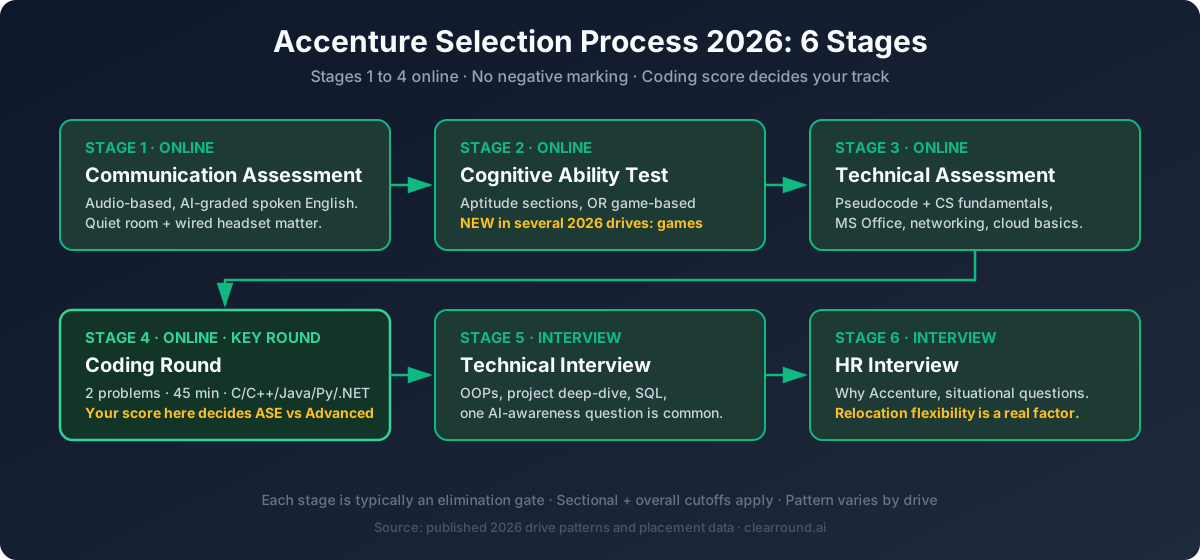
Stage 1: Communication Assessment
An audio-based, AI-graded spoken English test with no human evaluator. Reported formats vary by drive, from roughly 20 to 25 questions in about 30 minutes to longer 6-section versions. You will read sentences aloud, retell short passages, answer open questions and complete listening tasks.
What it actually measures: pronunciation, fluency, sentence mastery and vocabulary. It does not measure accent. Speaking clearly at a steady pace beats speaking fast in a forced accent every time.
Insider Tip: Most candidates fail this round from environment, not English. Use a wired headset, sit in a silent room, and speak 10 to 15 cm from the mic. AI graders penalise background noise and clipped audio as "unclear speech" even when your English is fine.

Stage 2: Cognitive Ability Test
This is where 2026 differs from every older guide you have read. Traditional drives run around 50 questions across verbal ability, reasoning and numerical ability inside a shared 90-minute window with the technical section. But several 2026 drives replaced these sections entirely with game-based questions, short interactive puzzles (around 3 games in roughly 20 minutes) that score your problem-solving process, not just the final answer.
You will not know which format you get until the drive notification, so prepare the underlying skill, not the surface format: pattern recognition, logical deduction, and quick numerical estimation. There is no negative marking, so attempt everything. Cutoffs are both sectional and overall.
Insider Tip: For game-based questions, the scoring watches how you work: how quickly you adapt after a wrong move, whether you test hypotheses systematically. Random clicking to "try everything fast" reads as poor decision-making even if you stumble into the answer.
Stage 3: Technical Assessment
MCQ-based, covering pseudocode (the biggest chunk), CS fundamentals, and a section most freshers do not expect: common applications and MS Office, plus basics of networking, security and cloud. Non-CS branches are eligible for Accenture, and this section is designed so that a mechanical engineer who prepared can clear it.
Pseudocode questions are usually C-style logic tracing: predict the output, find the error, count the iterations. If you can trace loops, recursion and pointer-style logic on paper, you are most of the way there.
Stage 4: Coding Round
Two problems in 45 minutes. Accepted languages: C, C++, Java, Python and .NET. Difficulty is easy to moderate, think array manipulation, string processing, basic sorting logic, not LeetCode-hard dynamic programming.
This round matters more than any other, because your coding score is what places you into the ASE or Advanced ASE track. There is no separate Advanced ASE application. Same test, same day; stronger coding performance, higher salary band. A partial solution scores better than a blank editor, so submit whatever compiles and handles the main case.
Insider Tip: Candidates aiming for Advanced ASE should solve the first problem fast and clean, then spend the remaining time making the second problem handle edge cases (empty input, single element, large values). Reported track cutoffs are unofficial, but complete-plus-robust beats two half-attempts in every candidate account we reviewed.
Stage 5: Technical Interview
For freshers this stays close to fundamentals: OOPs concepts with real examples, your final-year project (expect "why did you choose this tech?" and "what broke and how did you fix it?"), basic SQL, and one language of your choice in depth. In 2026, interviewers increasingly add one AI question, not to test expertise but to test awareness: how you have used AI tools in projects or study, and whether you understand their limits. Have an honest, specific answer ready. We covered how to structure it in How to Answer "How Do You Use AI in Your Work?".
Stage 6: HR Interview
Mostly conversational: tell me about yourself (use a tight structure, see our Tell Me About Yourself guide), why Accenture, strengths and weaknesses, and situational questions.
One question here quietly rejects more candidates than any technical gap: relocation. Accenture staffs across Bangalore, Hyderabad, Pune, Chennai, Mumbai, Gurgaon and more, and candidate accounts consistently report that restricting yourself to one city significantly hurts selection. If you can genuinely relocate, say so without hedging.
ASE vs Advanced ASE: What You Are Actually Competing For
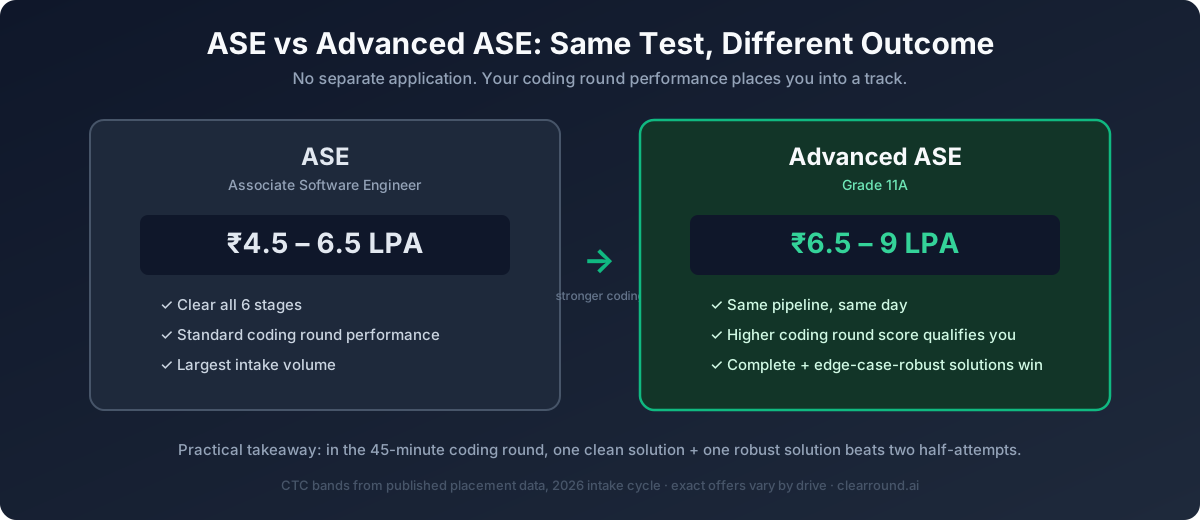
| Comparison | ASE | Advanced ASE (11A grade) |
|---|---|---|
| CTC band | ₹4.5 to 6.5 LPA | ₹6.5 to 9 LPA |
| How you qualify | Clear all stages | Same pipeline, higher coding round performance |
| Separate application? | No | No |
CTC bands are drawn from published placement data for the 2026 intake cycle; exact offers vary by drive and role.
Why Accenture Is Worth Targeting Right Now
Three facts from Accenture's own reporting make the 2026 case:
- Hiring is recovering. Accenture added 2,741 employees in Q2 FY2026, taking the workforce to 786,432, after a long cautious phase across the sector.
- The company is rebuilding around AI. Its data and AI workforce grew from 40,000 in FY2023 to 77,000 by the end of FY2025, targeting 80,000, and over 550,000 employees have been through GenAI fundamentals training.
- Fresher hiring explicitly favours GenAI-aware candidates, mirroring what we found across the sector in our look at India's tech hiring slowdown: the market is quality-over-quantity, and AI awareness is the quality signal.
None of this means you need to be an ML engineer. It means the fresher who can say "here is how I used AI tools responsibly in my project" beats the one who cannot, at the same coding score.
Your 3-Week Prep Plan
Week 1: Online stages. Daily pseudocode tracing (10 questions), aptitude fundamentals, and record yourself answering spoken prompts for the communication round. Fix your resume against the JD first; our fresher resume format guide covers the ATS side, or run it through the ATS resume checker.
Week 2: Coding. Two timed problems daily in your strongest language, 45-minute blocks, exactly like the real round. Prioritise arrays, strings and basic logic over hard algorithms.
Week 3: Interviews. Prepare your project story, OOPs with examples, your AI-usage answer, and your relocation answer. Then practise out loud. Reading answers silently and saying them under pressure are different skills, which is exactly what a company-specific mock interview is for: ClearRound loads Accenture's interview patterns and scores your spoken answers across 5 dimensions.
The candidates who clear Accenture are rarely the smartest in the room. They are the ones who knew the format, attempted every question, wrote code that compiled, and said "yes, I will relocate" without flinching.
Practice with our AI interviewer
Voice mock interview with scored feedback. Free session.
Start a mock interview →Frequently Asked Questions
Priti
AI interview preparation insights from the ClearRound team.